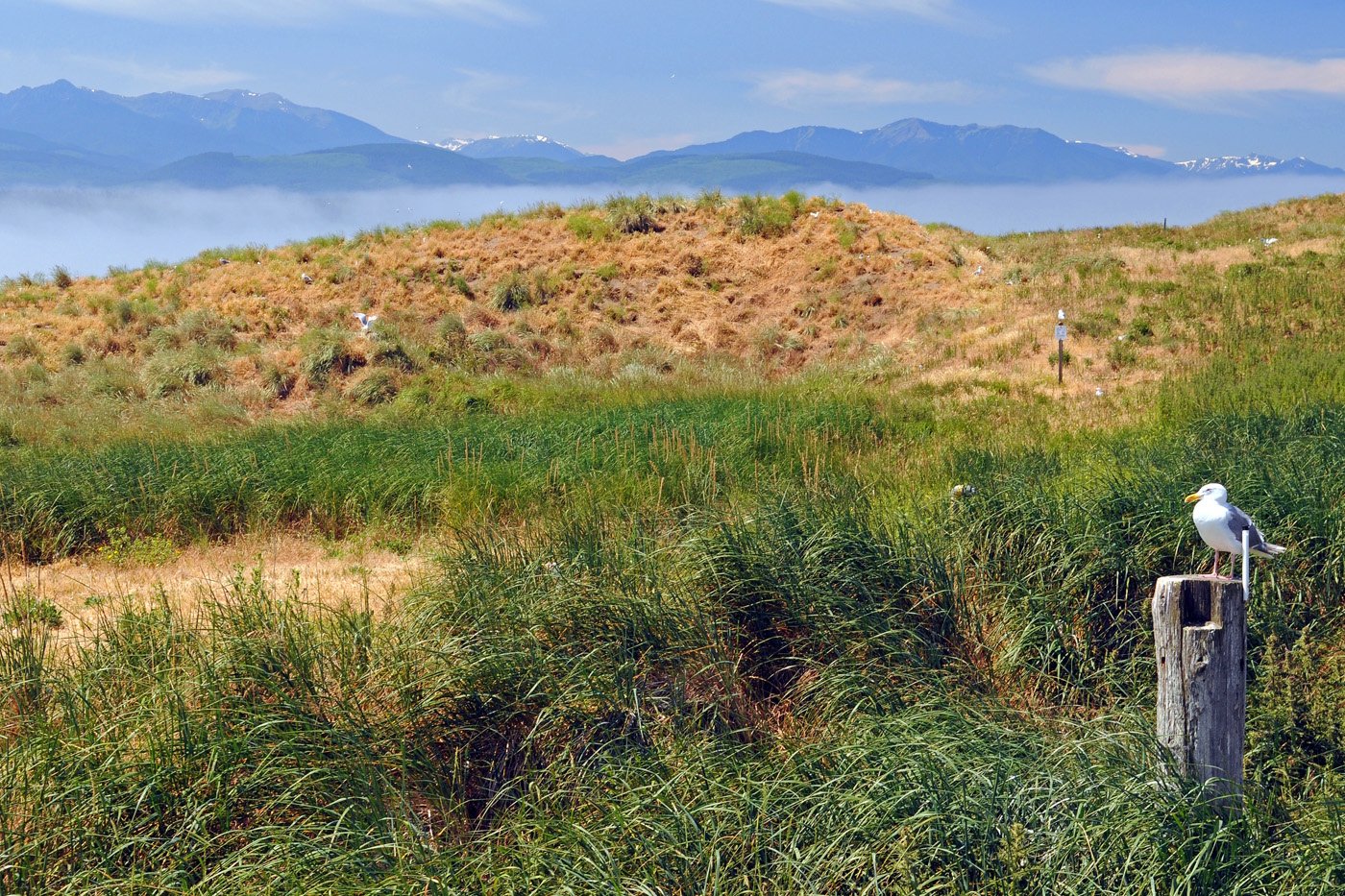
Protection Island upland habitat—Photo: Peter Davis/USFWS
July 2025
The Importance of Habitat, OPAS Conservation Committee, and You
by Joyce Volmut

Habitat refers to the foundation of resources that plants and animals need to survive and reproduce. It is the place where a specific plant, animal, or all human life lives a healthy life. It includes food, water, light, sound, cover, and space. Whether they can survive depends upon the species' needs. Birds need the right habitat to survive. Different species of birds require very different habitats. What they eat, how they find food, and what they require for nesting are very dependent upon the physical characteristics of the bird and their ability to adapt.
Some birds can live in a wide range of habitats and are comfortable in suburban or urban environments. Others have more specific habitat requirements, like the Marbled Murrelet, which lives in the ocean but must travel to an old-growth forest to breed and raise its young.
Most species of birds have the ability to adapt in order to survive. For example, cavity nesters have adapted to nest boxes, and certain raptors have adapted to platform nests when their nesting sites have been destroyed.
OPAS Conservation Committee
I have written about the Conservation Committee in the past and the need for new voices, new eyes, a new passion. But what is conservation all about, and what does the Conservation Committee do? It is made up of members with a desire to conserve habitat. The committee responds to threats to birds from changes in federal, state, or local policy, discusses issues that affect birds, reports to the board, and makes recommendations.
Today the committee’s mission hasn’t changed, but today's members have taken a more active role in protecting birds. The committee co-chairs are Bob Phreaner and Joyce Volmut.
Bob is a volunteer for Streamkeepers, past OPAS president, a participant in the Puget Sound Pigeon Guillemot study, and one of the original initiators of the Swan Safe project.
Joyce started the Western Bluebird Watch, coordinates the National Audubon Climate Watch Program, organized International World Migratory Bird Day and Lights Out proclamations in the City of Sequim and Port Angeles, and is in the process of developing an OPAS partnership with a local chapter of Dark Sky International.
Katja Bridwell, along with other OPAS members, initiated the North Olympic Wildlife Habitat Project.
Ken Wiersema, a longstanding OPAS member—whose accomplishments are an article in themselves—was concerned about the decline of Purple Martins on the Olympic Peninsula. This led to the start of the Purple Martin Project, including the design of the nest box that is currently used and called upon by other networks of Purple Martin programs across the country.
John Acklen’s leadership as a retired electric power industry employee and former environmental science project manager was admirable while he worked with the PUD on developing guidelines and tools for use in the Swan Safe program to prevent electrocution of swans.
Lance Vail, whose expertise is hydrology, is a member of the Water Resources Technical Group for the Dungeness River Management Team.
Dee Renee Ericks, who is the OPAS Facebook coordinator, leads Project BirdSafe and has done an outstanding job partnering with the Peninsula College BirdSafe program.
Mary Porter-Solberg, a past Conservation Committee co-chair, is the OPAS webmaster who publishes the Harlequin Happenings newsletter and ties everything together.
It is important to remember that all of conservation is about trade-offs. As members of OPAS, we don’t have to choose or take sides. Our job is to educate, advocate, protect birds by keeping their needs in mind, and negotiate the best possible route to conserve habitat.
So, I’m asking you to find your project:
Participate in a Community Science program.
If you live in the city, celebrate your backyard birds—help your city become more bird friendly.
If you like to photograph birds, send your pictures to the OPAS Facebook coordinator.
If you like to write, share a story about a birding experience in your life and submit it to the Harlequin Happenings coordinator.
Join a birding experience.
Join Climate Watch to help scientists learn more about how birds are adapting.
Join Bob Boekelheide on Wednesday’s Nature Center Bird Walk.
Review OPAS field trips and see what interests you or suggest a field trip to the field trip coordinator.
Learn how to make your yard and neighborhood bird-friendly by joining the North Olympic Wildlife Habitat Project and planting native plants.
Practice bird-safe measures: keep your cat indoors, use bird-friendly tape on your windows, and install downward-facing outdoor lights.
Sign up to take action to protect birds—it's simple, only a click away.
Audubon Washington: Take Action
Or go to the OPAS website, click on the Conservation tab, then Take Action.
Be a voice for birds by becoming part of the Conservation Committee. Keep us on track where conservation matters. Today, this is more important than ever.