
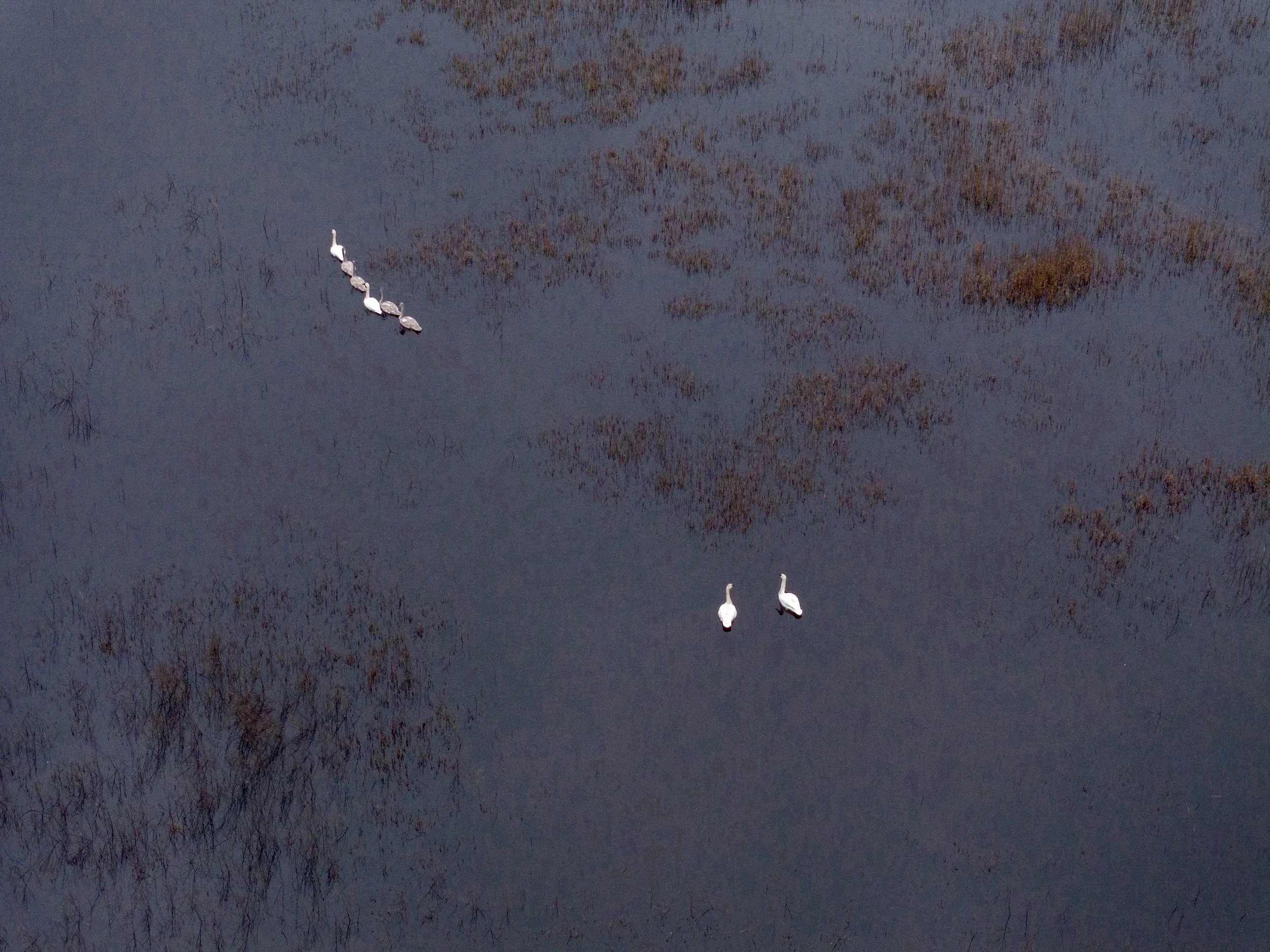
Trumpeter family and adult pair on Gierin Marsh during a January dawn. Photo: John Gussman
The Swans Among Us:
2025–2026 Season Summary
OPAS Swan Team's 2025–2026 data-analysis graphics
by Liam Antrim and Laura Davis


Our local insights and comparative data charts continue to grow from the OPAS Swan Team's long-term community science study in the lower Dungeness Valley. Fifteen years of regular observations and survey data help us illustrate changes through the years and within the five-plus months we observe Trumpeter and Tundra Swans during their overwintering period and migration across the local landscape. In this article, we amend our findings with the most recent season, including the regional swan counts from Washington Department of Fish and Wildlife (WDFW) and cohorts.
We cannot say when this past 2025–2026 season “kicked off” because it simply “dribbled” slowly into place. Swans settled into a daily routine here with individuals, families and flocks that we began to recognize. Although a pair of swans was spotted in flight during our November 4th survey, November 26 was the first survey date on which swans were seen foraging in the lower Dungeness Valley (Figure 1). In past years, the first non-zero count has been in late October or early November, but it has been also been as late as November 20 (2019). This season, in spite of the later start, the swans had a typical March ramp-down and were with us in the lower Dungeness Valley through the April 1st survey. From the November 26th survey, swans were present for a 127-day period—on the shorter end of a season that has ranged from 121 to 160 days.
Figure 1: Numbers of Trumpeter and Tundra Swans Counted During Midday Surveys by OPAS Volunteers, 2025–2026
Peak count—Trumpeter Swans migrate seasonally from summers breeding in the northern boreal forests and wetlands to the areas they overwinter. As a result, we see numbers of swans fluctuate when they move across the lower Dungeness to locations both north and south of the Olympic Peninsula. Our swan counts usually build over the season. Peak counts often occur in late February, likely capturing some additional flocks in northward migration. Past peak counts have ranged from 89 (Feb 2024) to 258 (Feb 2017) (Figure 2). This season, the peak count occurred in late January. This matched the lowest previous peak at 89 swans, but the timing did not correspond with the swans' normal migration pulses. Although this may indicate that we did not have a consistent cohort of swans over the season, we also have reason to suspect swans “hidden” and overlooked during surveys in the abundance of pasture grass and winter-grain options available to them.
Our March 31, 2026 article “Trumpeter Swan Memories of Water and Lead” also provided some insights into the low swan numbers, weather, changing agricultural practices, swan foraging preferences, and use of water.
Figure 2: Peak and Mid-Winter Average Numbers of Swans Counted by OPAS Volunteers, 2014–2026
Mid-winter population—To estimate overwintering swan abundance in our area, we use early December through mid-February as the period of winter residence, as indicated by eBird for Pacific Coast Trumpeter Swans, and calculate an average swan count for this mid-winter period. In past years, our mid-winter average has ranged from 68 swans (2023–24) to 201 swans (2020–21). For the 2025–2026 season, our mid-winter average population was 61 swans, which is the lowest mid-winter average since our surveys began in 2014 (Figure 2). The swans' late arrival, lower numbers and variation in our weekly counts during the overwintering period (n=36 to 89, Figure 1) lowered the mid-winter average.
Our mid-January count tallied 81 swans; WDFW and partners use a single mid-January survey of northwestern Washington and southern British Columbia to estimate overwintering swans in the region. Region-wide swan abundance increased this past winter. The WDFW January 2026 count was higher than the previous three years, at about 17,000 swans. Since 2015, this survey estimate has ranged between 14,000 (2025) and 20,000 (2017) Trumpeters, with the exception of a low of 10,619 in 2024, likely reflecting poor 2023 nesting conditions, the January 2024 hard freeze, and impacts from avian flu. Given the relatively high number of swans counted in the WDFW regional survey this past winter, our relatively low swan numbers do not indicate a problem at the population scale. From the Olympic Peninsula, OPAS and partners contributed for this survey a total of 169 swans in the lower Dungeness, Chimacum Creek Valley, and Neah Bay.
Percent juveniles—During the 2025–2026 mid-winter period, we saw an average of 21% juveniles (ranging from 11% to 31% in weekly surveys), our highest estimate since the 2015–16 season (Figure 2). Higher percentages of juveniles indicate good productivity within the Pacific Coast Population, and the WDFW mid-January swan survey showed a similarly strong juvenile ratio this season. As is typical for us here, the higher percentages occurred early and late in the season, as family groups with juveniles moved into our study area earlier or remained longer than adults without juveniles.
Post-harvest carrots lying on the soil surface adjacent to greens attracted the swans early. Photo: Laura Davis
Daytime foraging use—Swans initially focus their post-migration interests on foods providing carbohydrates. With the swans' late arrival in 2025 and corn fields absent in the study area, they found remnant carrots in a harvested field just west of Ward Road adjacent to green winter grain cover-crop species. Over the course of winter, the swans shifted over to pasture grasses while also continuing to forage on fields with the cover crop (Figures 3 and 4).
Figure 3: Week-by-week Observed Swan Foraging Habitat Usage During Midday Surveys, 2025–2026
Figure 4: Fields with harvested carrots and cover crops sustained 37% of their attentions through mid-January as shown here, and in Figure 3. From mid-January on, pasture grasses and different fields with cover crop accounted for half their foraging activity.
A forage-quality question came into focus this winter due to the conversion of corn fields to grains and pasture grasses for livestock fodder. We were interested in evaluating swan foraging preferences on the different “pasture” types. At two locations over this past winter, we observed swans foraging on recently managed fields (e.g. tilled and replanted with low species diversity) immediately adjacent to untilled pastures with a mix of grasses and greens. The swans showed no preference and moved between adjacent fields. Although we had heard the nutritional content would differ in favor of the recently planted grasses, we found there to be no strong preference (indicated by usage) for either pasture or grass type, nor was there a shift between the two forage options over the course of the season. Although we do not have information on nutritional content of the different field types, we can infer that both pasture types provided quality foraging opportunity for swans. Further, over several seasons of analyzing usage on pasture grasses versus cover crops, we observe increasing usage of the “green proteins” as spring approaches, but no indication of a preference for one type of managed grass or green winter grain over another. (See data-analysis graphics link.)
We saw more swan use on the west side of the Dungeness River than in recent years. While availability of forage greens was extensive, it may have been the early “find” of carrots at Ward Road plus availability of daytime water near the Sequim Valley Airport that biased swans in the westerly direction (Figure 5). Although the swans showed fidelity to some foraging locations (e.g. Ward Road and Carlsborg), there was also significant shifting between locations from week to week, including to new fields we had not observed swans foraging in the past—south of River Run Farm between Old Olympic Highway and Woodcock Road, and a field east of Sequim-Dungeness Way along Woodcock Road. We do not know how much of the swans' shifting foraging distribution can be attributed to swans moving in and out of our study area over the winter season.
Figure 5: Observed Swan Foraging Location Usage During Midday Surveys, 2025–2026
Roosting and water—All swan roosting that we observed occurred on open water, which offers protection from terrestrial predators. We time our early morning roosting surveys to catch swans before their expected dawn flights to foraging locations. After a late season start, the mid-December morning counts at Kirner Pond clearly accounted for all swans observed during midday surveys, so we used the team's daily observations at Kirner and a few other sites in place of a full-team survey of eleven sites. Roosting surveys completed in January, February and March 2026 revealed shifting roosting preferences over time (Figure 6). We saw less use this year of the Gierin Creek marsh which outlets in Graysmarsh; this may relate to decreased foraging in the east-side fields. The usage of ponds near the airport and Agnew has ramped up these past two seasons. We attribute this to the lack of water on fields in our area to help them digest their forage. Although swans have been foraging near the airport for as long as we have surveyed, the local overnight usage seems linked to their increasing interest in forage locations near a reliable source of water.
Figure 6: Observed Swan Roosting Location Usage During Monthly Dawn Surveys, 2025–2026
As occurred in recent years, most swans were roosting on Kirner Pond early in the season and shifted away from Kirner Pond to other locations by February. Daily observations at Kirner Pond are invaluable in helping document roosting preferences at a fine scale. These details are not revealed in our monthly roosting surveys, which are snapshots of usage by a flexible and mobile population.
Among the first swans to settle in our area was this Trumpeter family with a juvenile (at center) that seemed to need the rest. It took a couple of days to fly off Kirner Pond for daytime forage. Photo: Bob Phreaner
Tundra Swans—We spotted a single juvenile Tundra Swan in most surveys between December 10 and the last departures at the end of March. This swan appeared well integrated with the Trumpeters and we observed no harrassment. We also counted a single adult Tundra Swan for three weeks in March. We watched for, but observed no interaction between the juvenile and the adult who was likely just passing through on its northern migration.
This juvenile Tundra Swan mingled easily among the Trumpeters for much of the season. Here, it grazes on cover-crop greens adjacent to a harvested carrot field. Photo: Dee Renee Ericks
GPS collared swan—An adult Trumpeter Swan with a GPS tracking collar from the WDFW–Humboldt study traveled south with another adult swan to visit the lower Dungeness Valley for a few hours on November 3 before heading north again to Vancouver Island. Next sighted in early January, the collared swan was seen on about half of our surveys between January 7 through March 10. We look forward to looking at tracking data to see whether this swan moved in and out of the study area through the season, or simply was not sighted on some of our surveys.
Mortalities—Although WDFW has reduced its testing of wild birds for highly pathogenic avian influenza (HPAI), one sick swan was collected from the Chimacum Creek area in Jefferson County on December 18, 2025 and tested positive. No other HPAI cases in swans were reported for the season from the area. In February and March 2026, a listless Trumpeter on a pond near the Sequim Valley Airport was monitored, and then captured. Tests confirmed lead poisoning and it was euthanized, as covered in our March 31 post.
On February 15, one Trumpeter Swan experienced a fatal collision with power lines along Cook Road. This was near the site of a swan electrocution in 2024 that prompted Clallam PUD to install bird diverters on these power lines. Following the 2026 incident, OPAS volunteers reviewed this diverter installation, which was found to be compliant with recommendations. Given the timing of the incident, the collision was thought to be due to large numbers flying, a possible startle response to noise and low light conditions at dusk that reduced power-line visibility.
Season Finale—At the end of March, attentive commuters driving on Old Olympic Highway at the Agnew edge of our survey range reported a change in the family of five Trumpeters that had regularly foraged there since mid-March. The two adults had apparently started migration; the three juveniles were the only swans remaining in the area. As one juvenile appeared to have a wound on its side, we monitored and noted the birds able to fly back and forth to their overnight roost near the airport. These three juveniles remained for our April 1 survey, and we last saw them in the afternoon of April 2, foraging closer to the airport. At 8:15am the following morning, twelve eBirders north of Victoria on the Saanich Peninsula posted photos of three juveniles without adults. Our last swans, ready to head northward, had apparently flown across the Strait Thursday night on the same flight path documented by the GPS tracking of a WDFW–Humboldt study Trumpeter in early November.
Team building—We have benefitted from a consistent and dedicated set of volunteers getting out on weekly swan surveys or making daily observations at roosting sites. This past year we expanded our observational capacity by engaging folks who live adjacent to two overnight swan roosting sites, an agricultural pond near the airport and a small residential lake south of Agnew. The consistent viewing of swan daytime and nightly use of these locations has provided insights into swan behavior and habitat needs well beyond what can be inferred from weekly and infrequent observations. Our heartfelt thanks goes to the volunteers who demonstrate commitment to the work and take pleasure in the pursuit of our winter swan visitors.