
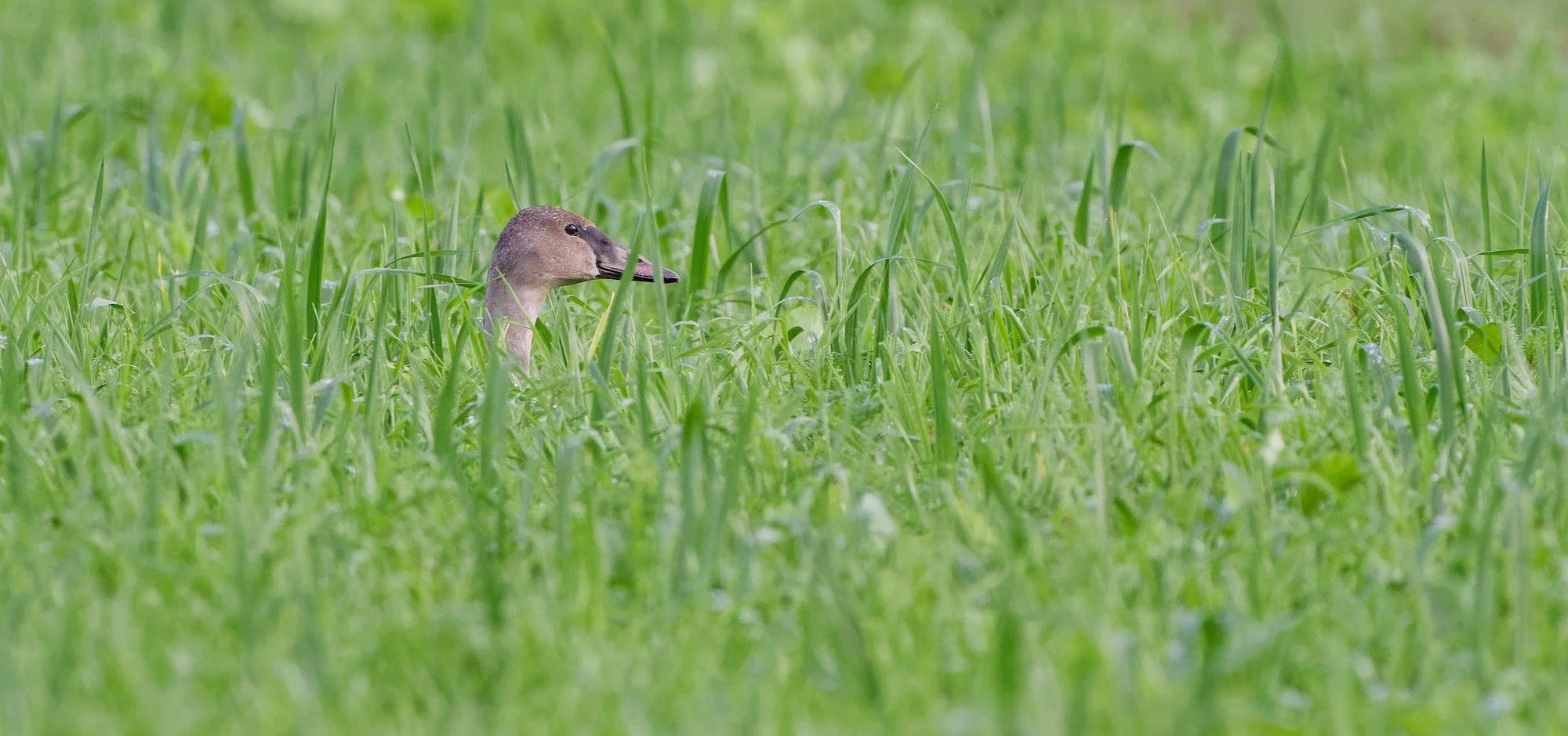
Trumpeter Swan juvenile—Photo: Dee Renee Ericks
Trumpeter Swan Memories of Water and Lead
by Laura Davis

A GPS-tracked swan flying north in November turned the concept of autumnal migration on its head for me. Swans had feasted on flooded agricultural crops along eastern Vancouver Island, while conditions in the lower Dungeness were parched. This collared swan and its mate had overwintered here last year and were familiar with the landscape. They arrived early in November but then, only a few hours later, turned north and flew the forty miles back toward the known resource on the Saanich Peninsula. Clearly there was little conservation of energy at play with these two Trumpeters.
Two Trumpeters on a Vancouver Island field of harvested corn, shiny with surface water on November 3, 2025. This GPS collared WDFW–CalPoly Humboldt study swan had overwintered in Sequim from December 2024 to March 2025. Photo: Jody Wells
We experienced our third winter in a row of warmer than average temperatures through much of this 2025–26 season, and it started very dry. At least as meaningful to our local counts of overwintering swans are the temperatures further north and east. Lower overwintering counts in our area may mean that swans found access to ice-free water and forage north and inland in British Columbia into the winter, then followed gradients of cold nights as necessary toward the south. As a small but indistinct subset of the total Pacific Coast Trumpeter population, and with many options and so many variables at play, we avoid drawing conclusions regarding cause and effect from our data.
With fewer numbers arriving, I likened this year's early swan season observations here to a drip, drip, drip leak in a faucet with a slow drain. When swans numbers are higher, we don’t normally notice the flow through and down along the migrational corridor. Our weekly counts hung close to zero until the Thanksgiving week.
An animated and vocal party of Trumpeter Swans arrive to wet pasture along Chimacum Creek south of Port Townsend, December 2. Photo: Wendy Feltham
Although we expected closer to average temperatures this winter season, those of us watching the agricultural fields pre-season voiced concern that lower numbers of Trumpeters would choose to stay and overwinter here. Farmers transitioning away from dairy and toward beef production changed the crops planted for cattle feed. For over a decade, extensive landscapes of corn had been harvested for dairy-cow silage, which left grain and remnant cobs for swans and other waterfowl each winter. These fields' recent planting in pasture grasses significantly reduced the food available to the returning swans. What would fill the swans' need for carbohydates following a tiring migration, especially for the recently fledged juvenile swans?
In the end, the farmers' fields served up more than had met our eyes: small intense plots of carrots. In this case, the particular farmers had harvested the carrots before the swans had arrived. Astute swan scouts quickly found these fields with sunburned remnant carrots scattered on the soil surface. Immediately adjacent was the perk of well established fresh green cover-crop grasses to graze on, high in protein, and offering a balanced meal.
A pair of Trumpeters reach and twist their necks to quickly graze the surface of a thick patch of an overwintering grass species grown as cover crop. Video clip: Dee Renee Ericks
To build bodies for north-bound migration, protein dominates forage into spring and our landscape offered more options for nitrogen-rich pasture grasses. We saw most swan use of fields in close proximity to water for daytime digestive processing of the grasses. Some families frequented places away from the largest flocks and were seen there week after week.
Late winter took on its own drama in our OPAS swan-team world. Where swans found daytime open water and safe overnight haven on a small irrigation pond, watchful neighbors alerted us to a Trumpeter adult remaining on the pond through the day. Our team monitored this swan and its watchful and clearly devoted family for about ten days. We helped form the bridge between the empathic neighbors and WDFW staff who knew the swan would have to be significantly weakened to be moved from the pond toward possible treatment. It took dedicated regular observation to see the slow progression of symptoms, which pointed away from injury or avian influenza, and toward lead poisoning.
WDFW biologist Shelly Ament assesses the Trumpeter's condition and ability to evade capture on the pond. Photo: Laura Davis
The Trumpeter significally weakened, a WDFW kayak, two WDFW Wildlife Conflict employees, Liam and I helped herd it into a net and crate for testing at Discovery Bay Wild Bird Rescue near Chimacum. With an immediate blood test measuring high for lead poisoning, there was no possible rehabilitation. The professional teams made the determination that humane euthanasia to relieve the swan of its suffering was necessary. Radiographs showed a gizzard filled with small objects, which the swans consume to physically break down food. Careful scrutiny of the imagery by Martha Jordan of the Northwest Swan Conservation Association revealed steel shot, very round in profile with no eroded surface. It is likely the swan had fed in a hunting area where both steel and lead were present in the sediments. The lead pellets would degrade and appear deformed or tiny. Lead would be absorbed by the swan, causing the poisoning. As few as three lead pellets can kill a swan per Martha Jordan, who speculates that the swan carried the lead from points north or east, possibly from Skagit or Whatcom counties, or British Columbia. That it takes up to three weeks for a swan to die from lead poisoning may indicate that this swan family arrived in our area in early February, not long before the swan retreated to the safe haven of this pond and was seen unable to fly. We continued to watch for symptoms amongst the swan flocks who may have harvested sediments from the same wetlands along their migration route, but saw none.
Prior to this mortality, no lead-poisoning deaths had been recorded in our lower Dungeness study area in fifteen years.
OPAS Swan Team members monitored the swan's condition for daily reports to WDFW. Here, the mate stays on alert as the sick swan rests. Photo: Sarah Miller
Following clear skies and a waxing crescent moon, our survey numbers dropped by 60% on March 24. Families with juveniles dominate our flocks now (55% juveniles) with the first signs of what may be a slow northward migration. Nighttime temperatures remain sub-freezing along the swans' migratory paths through northern British Columbia and sub-zero on the Trumpeters' boreal forest breeding grounds. Please watch for our full-season report to OPAS members this summer.