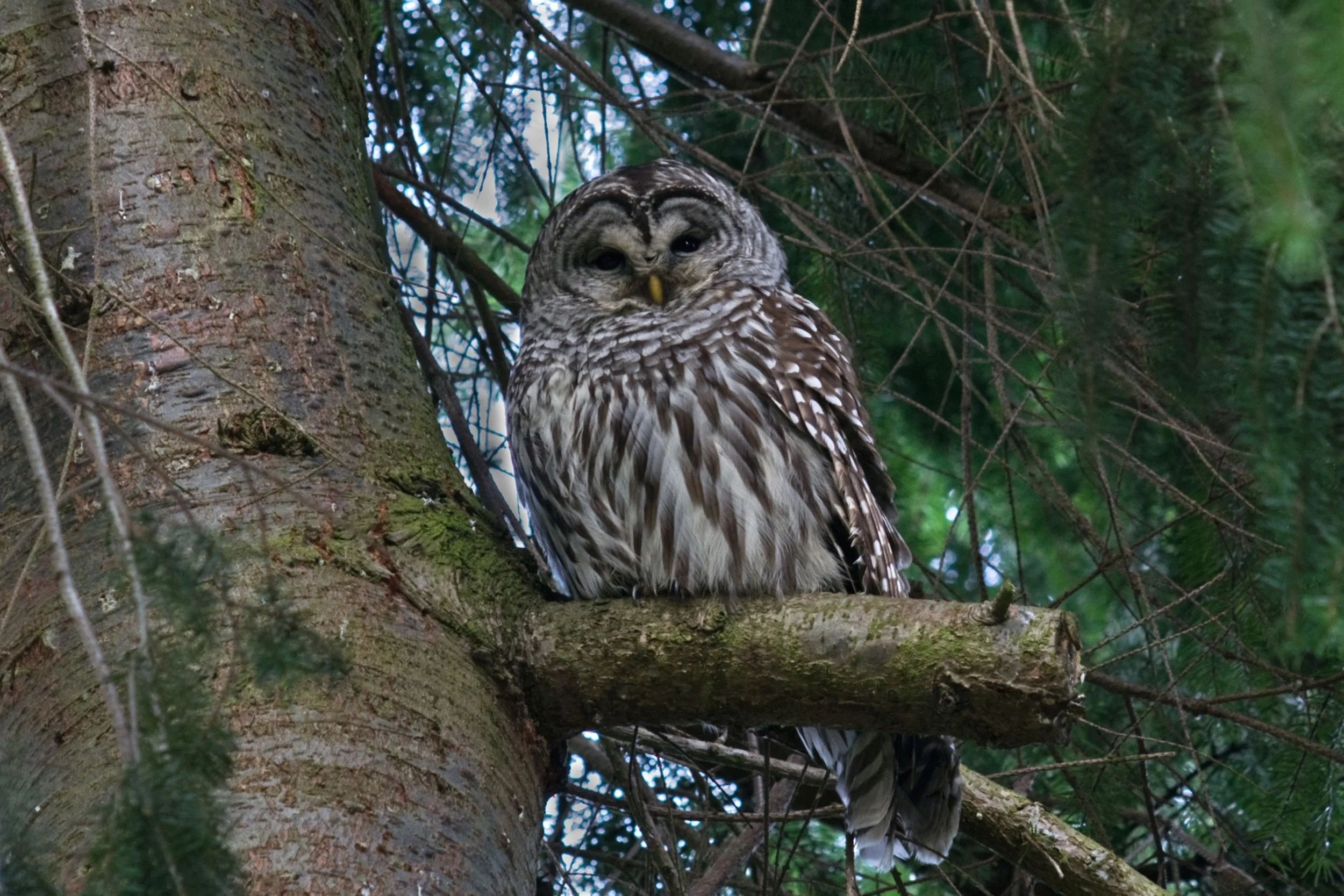
Barred Owl—Photo: Dow Lambert
March President’s Notes—Time to Walk (or Roll) the Walk
by Matt McCoy

We moved to Port Angeles in June 2022. There were many interior projects to keep us occupied during the last three years, and they are now mostly complete. (But really, can home improvements ever truly be considered finished, or just in an advanced state of usability? Ask the spousal unit.) Audubon has filled some of the time I previously devoted to boosting our economy. Still, there’s available time that could be spent on something other than doomscrolling. Enter: landscaping.
Of late, I’ve been asked to encourage general meeting attendees to enroll their yards in our North Olympic Wildlife Habitat Project and provide certified wildlife habitat for our feathered (and other) friends. Sadly, I am a hypocrite—our yard is not yet enrolled. Hope springs eternal; this should be the year we make the leap to a more wildlife‑friendly yard. It’s not a complete disaster in its current form. Kathy has compiled a respectable backyard list of over 60 bird species. Granted, Bald Eagles and Turkey Vultures probably haven’t perched in our trees, but we are firm adherents to the “if you can see it from the house, it counts” rule. Most species are regular visitors, especially with the help of liberal and diverse food supplements.
Prior to our arrival, our PA home was a rental and landscaped accordingly. There’s plenty of lawn, which our dogs really enjoy (it was absent from their previous abode), and some native plants—either volunteers or intentionally planted. The four Douglas firs are sad representations of their brethren in nearby forests. Fortunately, aesthetics isn’t the first criterion most wildlife use when selecting habitat. The trees provide great cover, an intermediate stop on the way to a feeder, likely nesting habitat for Anna’s Hummingbirds, a lookout for guarding feeders, and an occasional perch for Barred Owls who serenade us (and each other) on nights when we’re brave enough to leave the windows open.
The rhododendrons by the front door are awesome. They provide cover for birds using the adjacent feeders, and the lower branches offer an occasional hunting perch for an ever‑hopeful Cooper’s Hawk (granted, an unsuccessful one using this technique). Their spring flowers are beloved by pollinators—scores of bumblebees—and by hummers alike. In winter, their resting leaves form multiple mini‑umbrellas, creating drier spots for insects that Bushtits tirelessly hunt. Spotted Towhees scratch through the understory in search of seeds and insects, spreading debris onto the adjacent walkway for Kathy to clean.
We also have a few berry‑producing plants. The mountain ash has lovely white flowers in the spring. Its berries are the first to go in early winter, seemingly disappearing from one day to the next, enjoyed by American Robins, European Starlings, and itinerant Cedar Waxwings. Snowberry bushes also do well in the understory of a Douglas fir. Their berries aren’t very palatable, with some lasting through most of the winter. Finally, there’s the monster tall Oregon grape. Its spring flowers are visited by a wide variety of pollinators. The dense, well‑armed foliage and twisting branches seem impenetrable but provide great nesting habitat for towhees. Their berries are eaten in winter—after the mountain ash, but well before the snowberry.
Then there are the horsetails and sword ferns that provide cover and perhaps some insect habitat, but not prime bird habitat. The horsetails provide me with countless hours of entertainment behind a stirrup hoe, because I’m not above Sisyphean tasks. Left to their own devices, they would quickly crowd out more desirable plants—and maybe eat our house (some come up between the floor and foundation inside the garage and in the crawl space!)—so I battle on.
A quick run‑through of the National Wildlife Federation quiz (with some liberal interpretations) indicates our yard “encompasses all the NWF’s science‑based framework of habitat essentials needed to support generations of wildlife” and is eligible for certification. However, as retired wildlife biologists, we know we can do better. Our goal is to remove some lawn (the dogs are still in charge) and replace it with native plants. Please join us as we start that journey in the coming months.