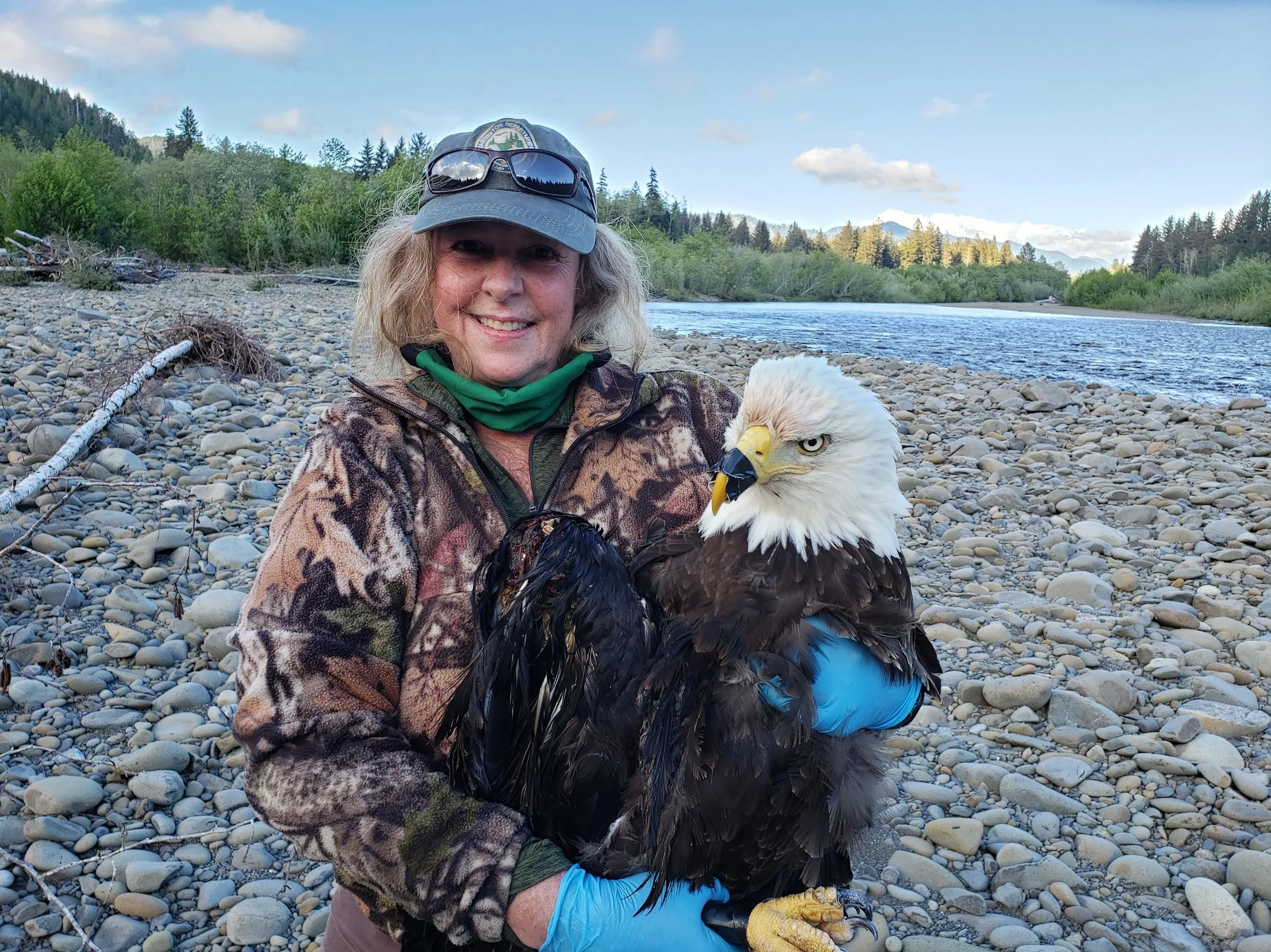
Shelly Ament with rescued Bald Eagle—Photo: WDFW
July 2026
Retired WDFW Biologist Shelly Ament Awarded for Career Achievement in Conservation
by Laura Davis and Liam Antrim

OPAS honors our long-term conservation partner, Shelly Ament, for her dedication to Olympic Peninsula wildlife and habitat conservation with this recognition for “Career Achievement in Conservation.” Recently retired from 34 years with the Washington State Department of Fish and Wildlife (WDFW), Shelly moved to Sequim in 1993 bringing experience from the National Park Service. With a personal interest in endangered species and an early focus with WDFW on Bald Eagle management, the de-listing of Bald Eagles from the Endangered Species Act vastly broadened her responsibilities. Across the Olympic Peninsula, Shelly has participated in numerous multifaceted studies of avian species including eagles, swans, shorebirds and waterfowl, as well as other wildlife including elk, bears, deer, butterflies, and bats. Her diverse conservation efforts have made ecosystem-scale contributions to local wildlife.
Shelly forded the Bogachiel River twice to retrieve this eagle with a fractured wing for possible rehabilitation at Discovery Bay Bird Rescue. Photo: WDFW
She conveyed to the human communities of the Olympic Peninsula assurance that we can live gently with wildlife. Sharing a trailer full of educational gear at public events and festivals, Shelly engaged curious kids and interested adults with her inviting nature and friendly smile. She advocated for wildlife and habitat and served as a local role model for service and stewardship.
Shelly volunteering alongside the Purple Martin team as they install nest boxes at Three Crabs in the spring. Photo: Dee Renee Ericks
Shelly excelled working at this human-wildlife interface with landowners, farmers, OPAS, and affiliate professionals. She calmed concerned residents when they experienced a problem, established trust among her conservation partners, and advocated for adjustments to the human landscape and infrastructure to support wildlife. She partnered and collaborated with OPAS on Trumpeter Swan, Purple Martin, Black Brant, and shorebird studies, but also volunteered her own time to OPAS community-science projects. In collaboration with Shelly and WDFW, OPAS colleagues have provided observations to identify risks to wildlife and have expanded human resources to assist with monitoring and response. These reports included insights from our Swan Team, such as swan flight paths near power lines or the unusual symptoms expressed by a lone swan.
Shelly assesses the condition of an adult Trumpeter Swan with suspected lead poisoning and the logistics involved in its capture. Photo: Laura Davis
Shelly was a strong advocate for the local overwintering swans. She encouraged long-term monitoring, posed proactive solutions to identified risks, and forged trusting relationships with community members. Co-author of the PUD Avian Protection Plan, she initiated work with the Clallam Public Utility District (PUD) to identify locations where risks of avian power-line collisions were high. Where risks were identified, Shelly collaborated with OPAS and the PUD to recommend placement of utility line markers/diverters. Kirner Pond is a prime example. After OPAS volunteers documented continuing swan power-line collisions and mortalities at Kirner Pond where power lines stretched directly across the swans' westerly flight path, Shelly served as the critical liaison between PUD, property owners, OPAS communicators, and project managers in the effort to divert and under-ground utilities. Shelly encouraged neighbors to allow the easements essential to the mitigation effort.
Shelly supported the efforts of the OPAS-led GoFundMe campaign, which generated $65k in donations toward burial of these overhead utilities. With a history of swan injuries and electrocutions, the overhead lines were a dangerous obstacle in the swans' typical flight path. Screenshot from promotional video by John Gussman.
Before and after: Above-ground utility lines adjacent to the important overnight swan-roosting site at Kirner Pond were relocated in 2021. Photo: John Gussman
Shelly responded to injured wildlife with empathy. On receiving a report from the field, she would head out at all hours of the day to retrieve a dead bird and assess the cause of death, or capture an ill or injured bird for transport and potential rehabilitation. Her prompt response to dead animals safeguarded scavengers like eagles and corvids from the spread of avian diseases. Shelly had the very complex job of determining urgency and filtering incoming reports while working with limited available time. She worked closely and thoughtfully with both our team and affiliate experts to scope out the options and necessary steps for rescue and rehabilitation.
Shelly plans a swan rescue near Chimacum with Gibbs Lake resident-manager and a Discovery Bay Wild Bird Rescue volunteer. Photo: Laura Davis
Shelly also worked with local farmers to mitigate wildlife impacts on commercial crops. She researched practical and effective methods, acquired materials and engaged volunteer teams with their installation on fields where crops, such as carrots, were threatened by swans feeding in the winter.
Shelly holds a pole with a mylar flag designed as part of a suite of non-lethal methods to deter swans from foraging on unharvested commercial crops. Photo: Bob Phreaner
To dissuade swan forage and protect the overwintering carrots from damage, Shelly, the farmers and volunteers installed cover cloth edged with mylar flags. Photo: Laura Davis
Her early collaborative study efforts with OPAS in the Dungeness Recreational Area led to the banning of lead shot in state wildlife areas. For her efforts as Assistant Wildlife Biologist, Shelly together with District Biologist Anita McMillan was awarded the OPAS Conservation Award in 2002, which included recognition for the lead-shot work. With the 2002 award, OPAS also recognized Shelly's work on eagle surveys and elk herd management, as well as her fundraising efforts for injured wildlife.
Shelly assisted with the capture of injured birds and thrilled in their recovery and rehabilitation. For 20 years, Shelly organized and hosted an annual fundraiser in support of Jaye Moore's work at the Northwest Raptor & Wildlife Center. Photo: Peninsula Daily News
As a valued conservation partner, Shelly’s leadership and lifelong commitment make her exceptionally deserving of this additional recognition from our OPAS community.
Liam Antrim and Laura Davis, Co-Leaders of the OPAS Swan Study team, presented the special Career Achievement in Conservation Award to Shelly Ament (middle). Photo: Dee Renee Ericks
Shelly previously received a Conservation Award in 2002. Photo: Shelly Ament