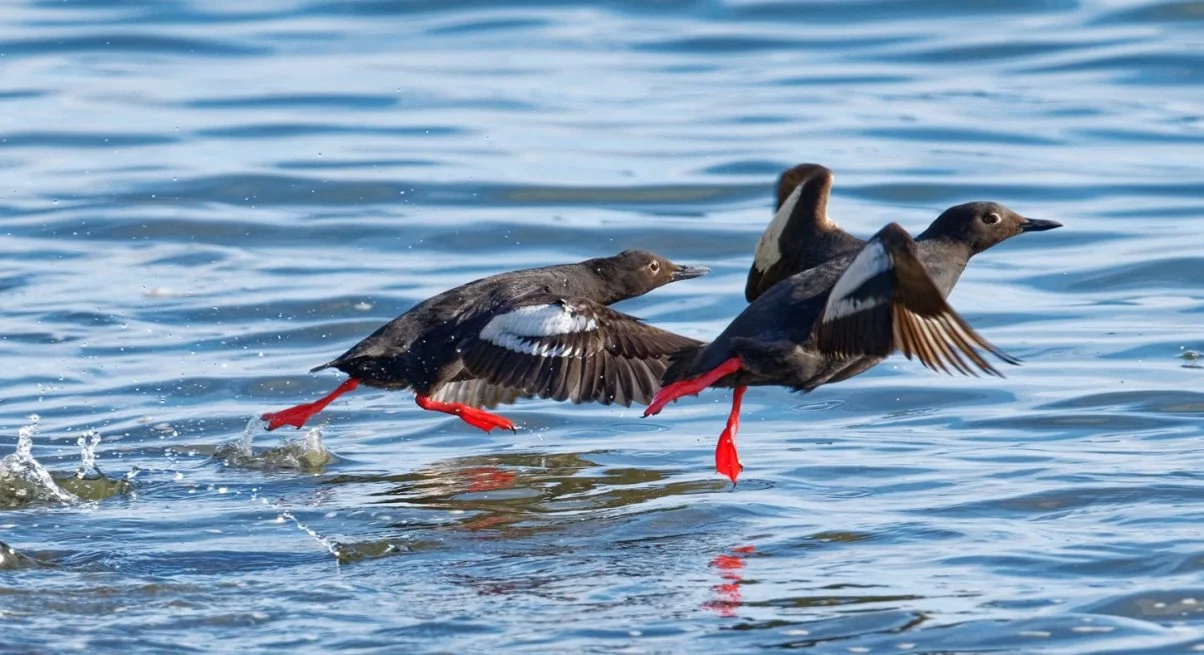
Pigeon Guillemots skimming over water—Photo: Dee Renee Ericks
May 2026
“Flaming Red Feet”
by Bob Phreaner

Maria Mudd Ruth was the keynote speaker at the BirdFest banquet on April 18, where she introduced her latest book, The Bird with the Flaming Red Feet. In it, she describes the Pigeon Guillemot (PIGU) as “a charismatic seabird with a surprising story to tell” and notes that although this often‑overlooked alcid doesn’t get as much attention as a puffin, it plays an outsized role in the health of marine ecosystems—earning its status as an indicator species. Her presentation, One Bird, One Beach, One Community, highlighted why this talkative little bird deserves more attention than its name might suggest. Pigeons are pedestrian, and how do you even say “guillemot” (pronounced GILL‑uh‑mott). Most of us simply call them PIGU. Why not just call the bird “Red Foot”?
The “Beach” in her talk refers to the erosional bluffs at the edge of the sea, where PIGU nest in old kingfisher burrows and raise two chicks from late May through mid‑September in our region.
The “Community” now includes more than 250 “guillemonteers” in the Salish Sea Guillemot Network, stretching from Whidbey Island to Olympia. To learn more about how observing this common seabird contributes to the study of the Salish Sea ecosystem, you can explore Maria’s engaging new book and visit mariaruthbooks.net (don’t miss Jonathan Mudd’s new “Alcid Rock” song).
In 2003, Frances Wood and Phyllis Kind initiated a community science survey of Pigeon Guillemot breeding on the bluffs of Whidbey Island. Since 2013, Maria and her team have collected data in the South Sound. Volunteers from the Clallam County Marine Resources Committee and the Olympic Peninsula Audubon Society have participated since 2014. The Salish Sea Guillemot Network formally organized in 2018, and observers in British Columbia will be added in 2026.
The monitoring protocols are scientifically rigorous, allowing researchers—who may not have the capacity to make these observations themselves—to use the data in studies of PIGU breeding behavior. A decade of data shows a stable population, thanks in part to the adaptability of this charismatic alcid compared to other seabirds.
Volunteer observers enjoy sitting quietly for one hour each week on a local beach, watching and recording burrow visits and enjoying the antics of these red‑footed seabirds. PIGU dive for benthic prey such as gunnels, carry a single fish crosswise in their beaks, skim low over the water to gain elevation, and then turn toward the bluff to deliver food to their chicks.
Most volunteers return year after year, but new observers are always needed—either for newly identified nesting sites or to serve as occasional substitutes when regular observers are away.
As a volunteer observer, you’ll be assigned a beach location where Pigeon Guillemots are breeding and feeding their developing chicks. After completing the required online training, new volunteers accompany experienced observers until they feel comfortable with the procedures. Observations begin the first week of June and continue for at least ten weeks.
Wearing neutral‑colored clothing to blend into the beach, you will arrive at the same early‑morning time each week. You will record the number of PIGU at the beginning, middle, and end of your survey, the times they visit their burrows, and the type of fish they are carrying. Don’t worry—after your first day, you’ll be able to distinguish the gunnels and sculpins that are the most common forage for our local PIGU. You will also note the time and duration of disturbances, such as raptors, walkers, and boats.
You will need a clipboard and pencil to record your data, at least 7x binoculars, and a lightweight folding beach chair is recommended.
Does enjoying quiet mornings on the beach watching birds sound appealing?
If you’re interested in becoming a Pigeon Guillemot volunteer and enjoying life on the beach, please contact me (phreaner@aol.com) or Ed Bowlby (edbowlby2@gmail.com).