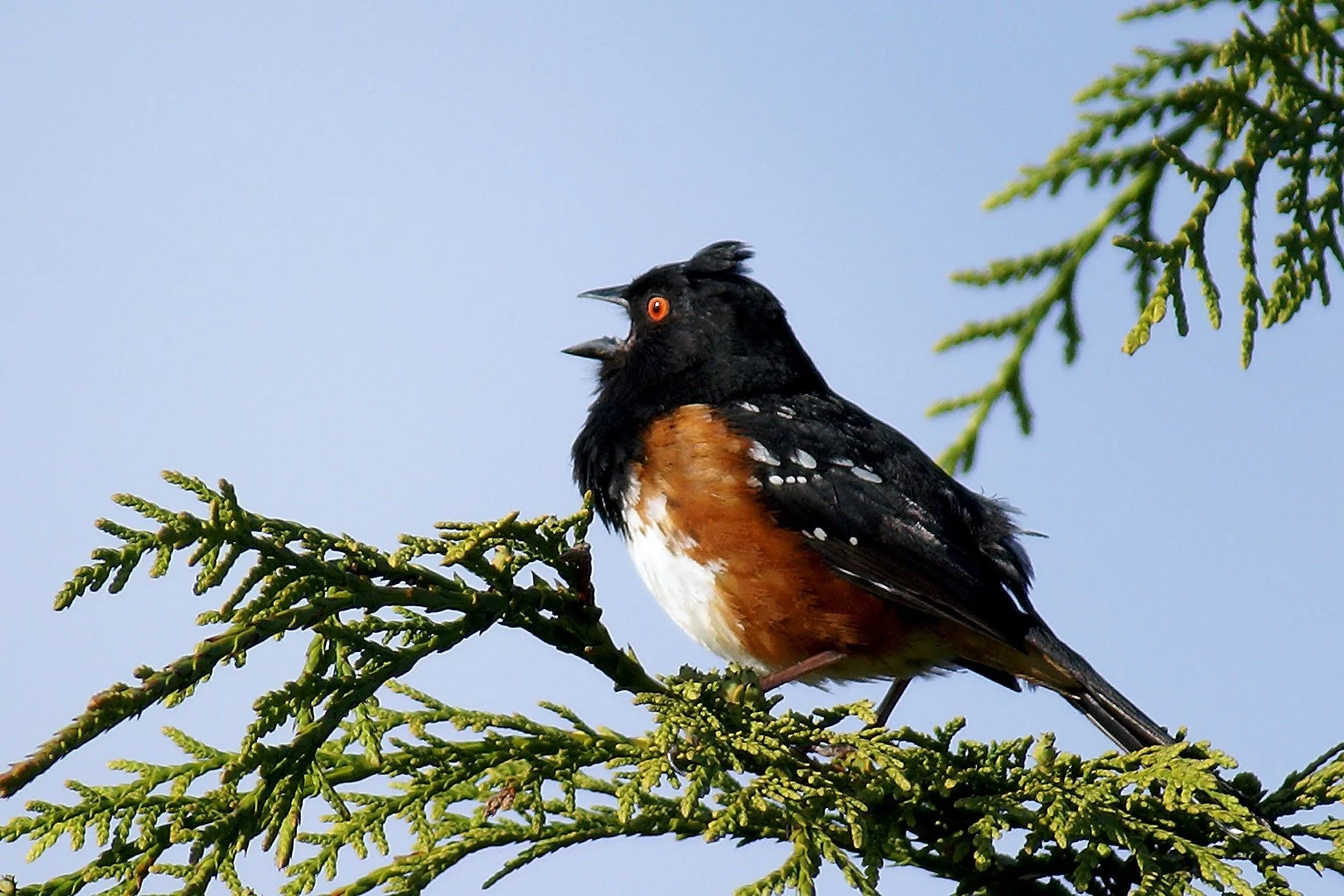
Spotted Towhee singing—Photo: Dow Lambert
March 2025
Let Bird Sounds be Heard in Our Cities
by Joyce Volmut

I recently attended a webinar on Bird-Friendly Communities. One of the speakers was Timothy Beatley who authored The Bird-Friendly City: Creating Safe Urban Habitats. According to Beatley, whose background is urban planning, cities don’t typically talk about birds in planning. Their usual conversation stems around streets and sewers, housing development, parks, zoning and so forth. He set out to change that with what he calls Biophilic Cities.
The COVID-19 pandemic was a life-changing event that affected us all in diverse ways. We saw the once-bustling streets of large metropolitan areas fall silent, as shown on television. This period of isolation forced us to confront solitude and adapt to new norms. During this time, many people began to view nature differently, finding solace outdoors. Birds captured our attention as we began to notice their sounds and marvel at their behaviors.
Beatley writes in the preface of his book, “Watching birds is therapeutic and entertaining, as birds behave and move and fly in ways that delight and astound us.” Any OPAS member can relate to this. My mother was a bird watcher. She didn’t necessarily know their names, but she knew how they lived, what they ate, and how the parents cared for them during nesting. I was inspired by her knowledge and care for all of nature.
Many of you may be familiar with the concept of Bird-Friendly Communities. Our initiatives, such as Project BirdSafe, the North Olympic Habitat Project, and our citizen science programs, are all designed with this theme in mind.
However, a bird-friendly city implies more than just making our backyards safe. It necessitates reaching out to neighborhoods and framing city policies to include bird habitats and bird-safe measures.
Recently, OPAS participated in a project and joined a coalition that aimed to ban commercial fireworks in the City of Sequim. A local resident who had visited Carrie Blake Park numerous times initiated this effort. She was captivated by the park's diverse bird species and the Bald Eagles nesting nearby. She successfully brought together several organizations, including OPAS, and presented the issue to the Sequim City Council. This initiative called for policy changes to protect nature, primarily due to the bird habitats the park provides.
Beatley encourages us to view our city from a bird’s perspective. He suggests examining the canopy of trees and comparing native plants to exotic ones. He discusses biophilic cities—cities designed to integrate urban living with nature. In such cities, mandates require the replacement of any green space lost during development, either on the development site or elsewhere.
Project BirdSafe, the North Olympic Habitat Project (NOHP), and the Backyard Birding program are examples of initiatives that engage the community. Through Project BirdSafe, we have partnered with Peninsula College to reduce bird strikes on campus. Through NOHP and Backyard Birding, we are reaching out to community members to create habitats suitable for birds. The community was also involved in Project Swan Safe, where members donated funds to help PUD resolve the issue of swan deaths caused by electric line strikes.
If you have a chance to read The Bird-Friendly City by Tim Beatley or go to biophiliccities.org, you would be amazed by the work that’s been done by cities across the globe to adapt their cities into bird-friendly places. Go to our Bird-Friendly Communities webpage to learn more.