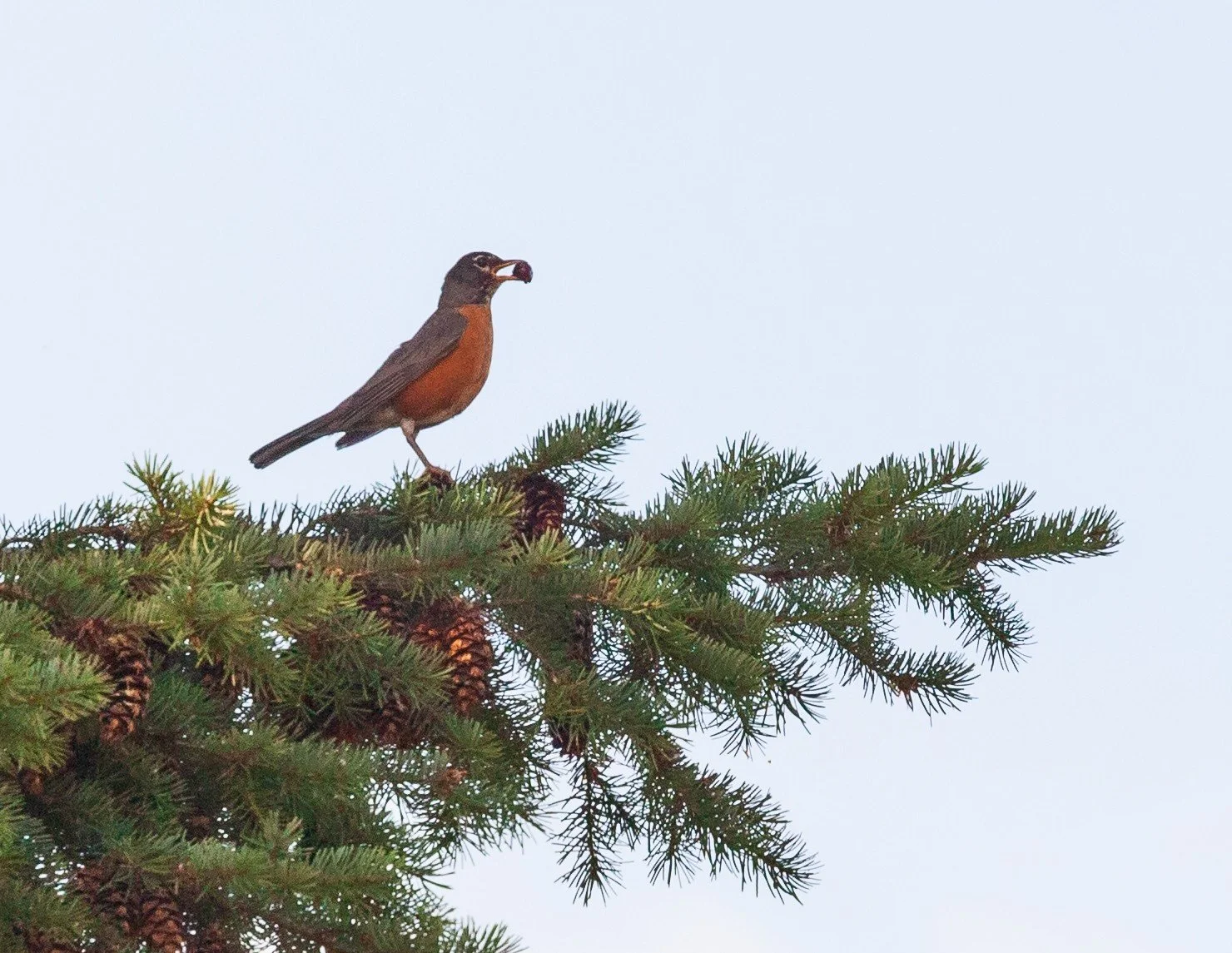
American Robin—Photo: Jane Nicholas
"When the Red Red Robin Comes Bob Bob Bobbin' Along"
By Jane Nicholas and Ida Domazlicky
If I told you I saw a bird about 10 inches long, dark grayish‑brown on top with a red‑orange breast and a white eye ring, you would likely suspect I’d seen an American Robin. Their characteristic way of hunting for worms and other invertebrates—quick starts and stops across the lawn—is another clue. They tilt their heads, patiently watching and listening for prey, and then—bingo!—they pull up a juicy worm and slurp it down. Robins are often the first bird a child learns, and I’m sure most of us have memories of watching their antics on the lawn. They can spark a lifelong interest in birding.
They were casually named for the European Robin because of the red‑orange breast, but the two birds are very different. The European Robin is smaller, solitary, and highly territorial, a member of the Old World flycatcher family. The larger, more gregarious American Robin is a thrush. There are several subspecies of American Robins, but they are so similar in appearance that telling them apart can be difficult. Typically, the Pacific Northwest robin (Turdus migratorius propinquus) lacks white tail corners and tends to be darker than robins found elsewhere in North America.
American Robin with earthworms—Photo: Dow Lambert
American Robins thrive in several habitats and are among the most abundant and widespread birds in North America. They have adapted well to living near humans. They’ll show up after we mow the lawn or run a sprinkler to grab an easy meal as worms rise to the surface. They also enjoy golf courses and parks. American Robins will build their nests close to our houses—sometimes even on windowsills or in planters. Perhaps our close proximity protects them by deterring predatory birds and other critters that would steal from their nests. Due to their ground‑feeding habits, they are vulnerable to roaming cats and pesticides—two things that can be remedied with a little thought and care from humans.
American Robins are the proverbial “early birds” in several ways. They are among the first birds to start nesting in spring. In some parts of the country, like Missouri where I grew up, robins migrate southward, and folks always looked forward to seeing the first robin of spring when they returned. In the Pacific Northwest, we are likely to catch an occasional glimpse in winter too. Here they don’t actually migrate; instead, they shift north or south with the 37‑degree isotherm. Some may head to the woods or to a lower elevation where food is more plentiful. Robins also switch their diet in winter to mainly berries and leftover fruit.
Robins are often the first birds we hear singing in the morning, which inspired the saying “the early bird gets the worm.” They are enthusiastic singers, especially the males. Their songs are fluid and complex, built from repeating phrases that sometimes sound like “Cheery, cheer up, cheerio.” A male’s repertoire is one of the traits females judge during breeding season. Pairs stay together while raising their young, tending fledglings for about a month. Parents may have up to three broods a year. Young birds can sometimes be heard singing softly to themselves as they practice their songs.
American Robin feeding its fledgling—Photo: Jane Nicholas
Their overall perkiness and sweet songs have endeared robins to humans through the ages. Some Indigenous communities, such as the Seneca, have songs and ceremonies honoring them. American Robins are the official bird of three states, and their European namesake is the national bird of Great Britain. Harry Woods wrote “When the Red Red Robin Comes Bob Bob Bobbin’ Along” in 1926, a hit throughout the late ’20s and ’30s. I imagine it lifted people’s spirits with lines like, “There’ll be no more sobbing when he starts throbbing his own sweet song.” Oblivious to their fame, robins just keep doing their thing and delighting people in the process. We can all look forward to seeing and hearing more robins this spring—and maybe we’ll softly sing this tune to ourselves in their honor: “…I’m just a kid again, doin’ what I did again, singing a song, when the red, red robin comes bob, bob bobbin’ along.”