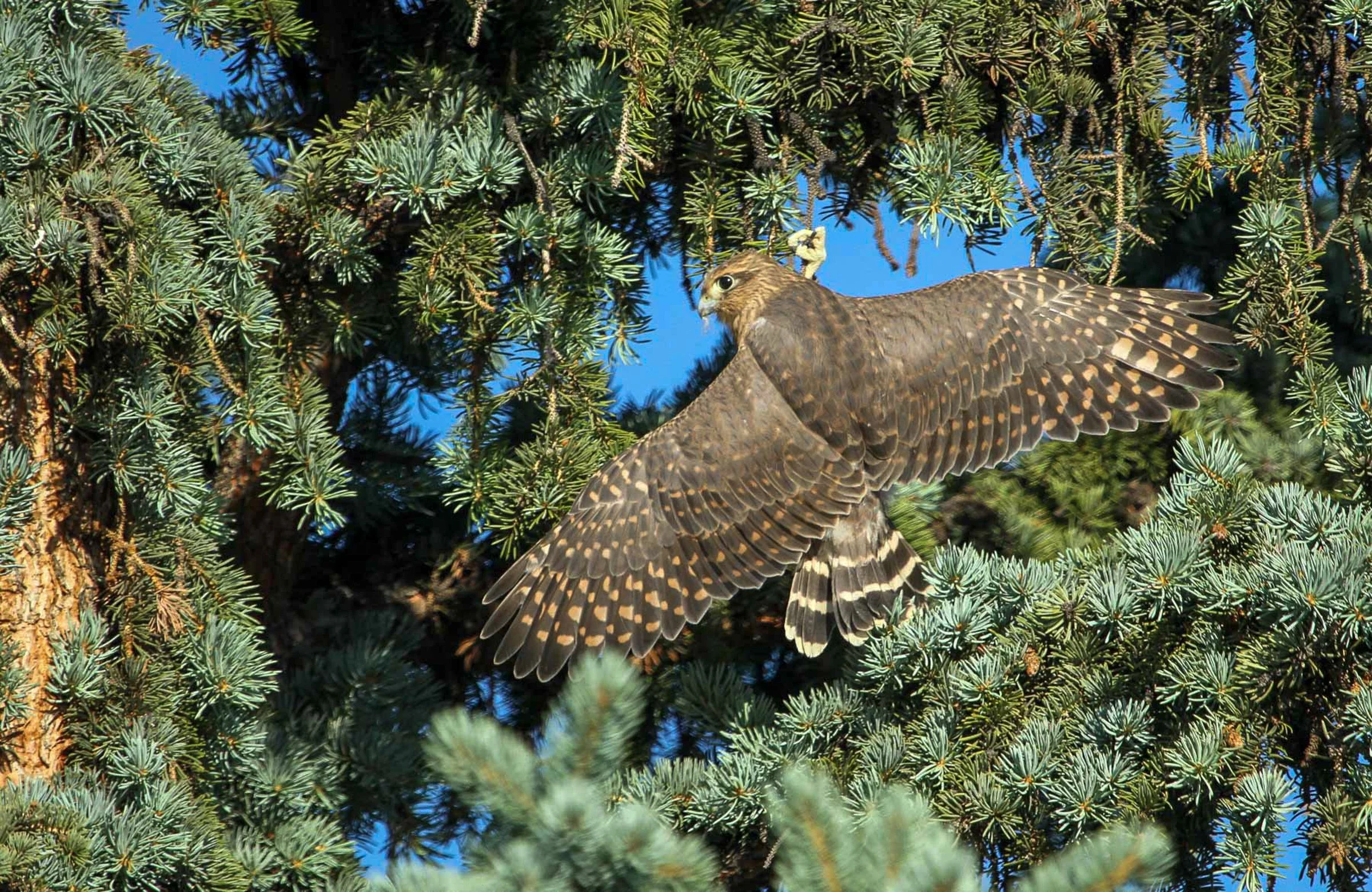
Merlin juvenile—Photo: Daniel Ellison/Audubon Photography Awards
Watch Out for Merlins!
By Ida Domazlicky and Jane Nicholas
The OPAS area is home to an incredible small falcon called the Merlin. Its common name has no connection to Arthur’s wizard but instead takes its name from a corruption of the old French word for a female hunting falcon, esmerillon. If you keep a sharp lookout, you may be able to see this lightning-fast little hunter zip over streets, houses or farms.
The Black Merlin, Falco columbarius suckleyi, is a subspecies of Merlin that formerly nested strictly in coastal forests from Washington to southeast Alaska. In the past 20 years, Black Merlins have expanded their nesting range to include forests and cities west of the Cascades, including Seattle. The other subspecies found here outside their nesting season is the Taiga Merlin, Falco columbarius columbarius. This paler Merlin subspecies nests mostly in Canada and Alaska, but migrates south through most areas of North America and even Central and South America.
Whatever the subspecies, a Merlin hunts on the wing. It may land on the tippy-top of a Douglas-fir and survey the area. Finding nothing, it zooms to a tree-top a football field away and looks again. (Trying to follow this bird around on foot makes a birder feel like a turtle.) An alternate hunting style is to speed along near housetop level at what looks like light speed. And indeed, although its nearest relative is a Kestrel, a Merlin is more like a tiny Peregrine Falcon. “The Merlin is to an American Kestrel what a Harley-Davidson motorcycle is to a bicycle,” wrote bird authorities Dunne, Sibley, and Sutton in Hawks in Flight. “In the air, the difference between a Merlin and an American Kestrel is not a matter of degrees, it is quantum.” (abcbirds.org)
American Kestrel—Photo: Dow Lambert
What are our resident Merlins looking for? In summer, one might take a dragonfly in mid-air. Only ten inches in length with a two-foot wingspan, this miniature hunter also considers songbirds and shorebirds fair game and seems especially fond of Dunlins. Fortunately for neighborhood birds, crows sometimes provide an avian early warning alert. When a Merlin shows up, crows often follow it, loudly protesting its presence. Since the Merlin is too small to take a crow, our crows’ diligence could be termed a volunteer act of public service. That said, Merlins often harass larger birds, apparently for fun. Maybe the crows remember a justifiable grievance. I once observed three large crows converge on a female Taiga Merlin in flight. At about half their length, she looked slender and delicate, and I was sure the little Merlin was done for—but Merlins punch above their weight. She screamed, circled, and dove viciously at each crow in turn, then glided serenely to her favorite perch in the Doug-fir tree line. The crows unceremoniously vanished and went silent. Only when the Merlin zipped away did a single crow cautiously circle her abandoned perch, apparently to make sure that the little demon was gone.
Merlin—Photo: Mick Thompson
Consider Merlin as an ID if you hear a sharp “kee-kee-kee-kee” or see a small, incredibly fast falcon with sharply pointed wings and a mustache. A Black Merlin will be overall dark to the point that its mustache isn’t easy to distinguish, while the mustache of the Taiga is clearly visible above a creamy belly. To distinguish a Merlin from a Kestrel, note the rainbow of colors the Kestrel wears, the Kestrel habit of bobbing its head and tail when perched, and its hunting style that relies on dropping from the perch onto prey. In flight, a Merlin appears unusually powerful and steady for such a small bird, and it often soars in wide circles with just a few quick wingbeats. Also, compare Merlin field marks to the Sharp-shinned Hawks that commonly take birds from backyard feeders. Merlins seem to disdain such easy pickings, preferring open country and the thrill of the chase, which is their special skill. And you may notice that, if the crows are doing their job, the songbirds know to sit tight when a Merlin is around. The crow cacophony is also your cue to grab binoculars and see what all the fuss is about. Crows hold many prejudices, but the object of their vituperation might just be a little avian fighter-jet that prefers to take its meals in flight.