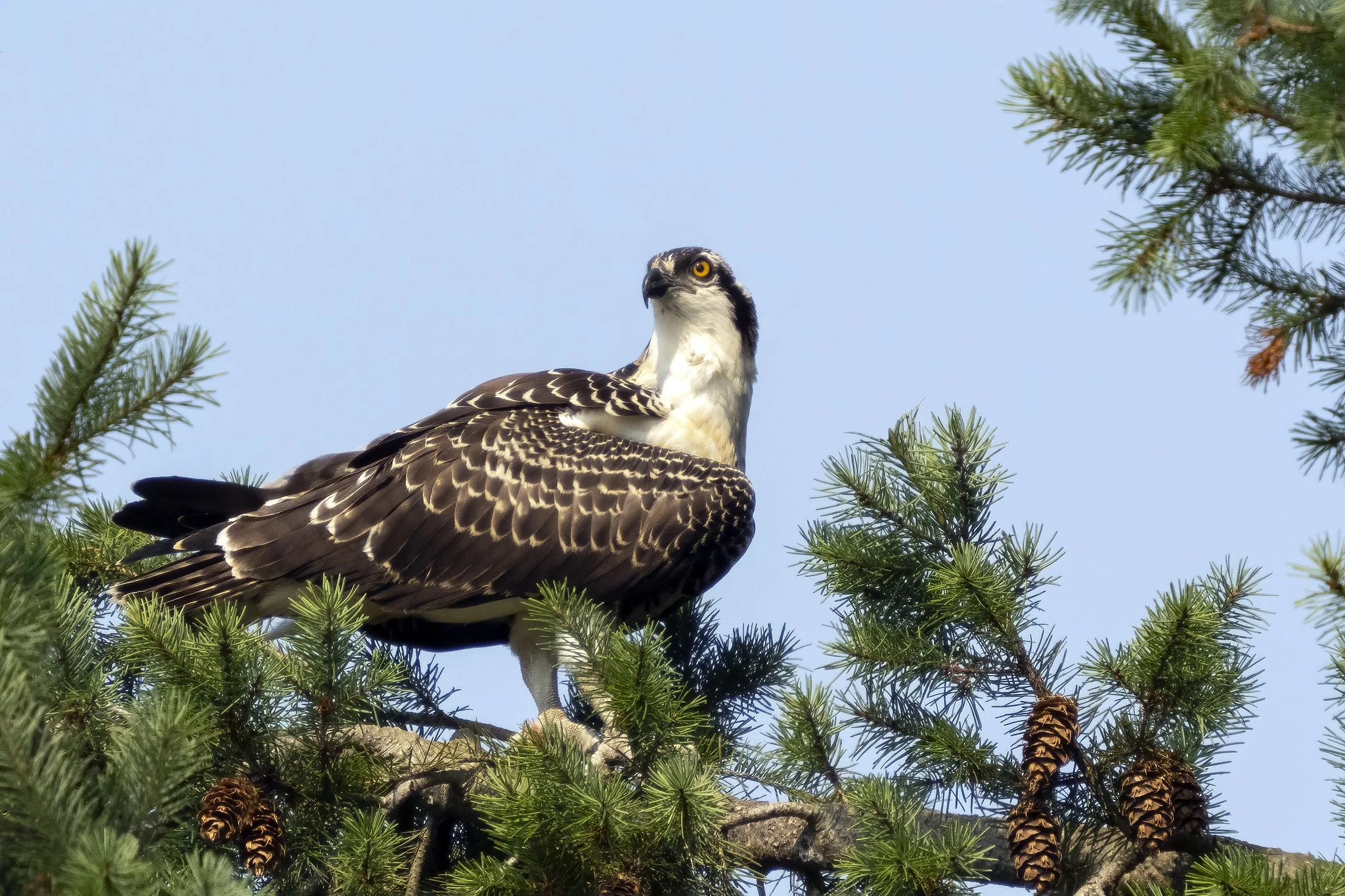
Osprey—Photo: Mick Thompson
Go Seahawks!
By Ida Domazlicky and Jane Nicholas
Despite my usual lack of interest in football, I happily cheered on the Seahawks at the Super Bowl. This was partly out of local pride, but also because of the team’s name—the Seahawks. The original “seahawk” is now best known as the Osprey, an amazing bird found in the Pacific Northwest as well as on every continent except Antarctica.
The Osprey also has special meaning to me personally. Years—and now decades—ago, an Osprey was my “spark bird,” the bird that sparked my obsession with birds. After neighbors convinced me to join them on a fall migration count, I spent a couple of frustrating hours trying to find small birds in trees using borrowed binoculars. Then an Osprey—whose wingspan is nearly six feet—circled above a nearby wooded lake. Without binoculars, I watched the graceful bird hover over the water and plunge in feet-first to pluck out a fish big enough to feed my family. As it flew toward a high bare branch, it paused in midair to shake water off its wings, then deftly reoriented the fish so it was facing forward. Once the Osprey settled on the snag, I was able to find it in the binoculars for a close-up look. I had seen many a wildlife program on TV, but this was happening right before my eyes. I was hooked on birds—and more than four decades later, I still am.
Osprey with fish—Photo: Mick Thompson
Ospreys make their homes on the Olympic Peninsula from spring through fall and are due back in March. In recent history, Ospreys nested more frequently in Clallam County, but as Bald Eagles recovered—particularly in the 1990s—they displaced many nesting Ospreys. The Sequim-Dungeness Christmas Bird Count in 1991 reported 31 Bald Eagles, but by 2001 the eagle count had risen to 178. Bob Boekelheide recalls that “there used to be Osprey nests at places like Sequim Bay, up Cassidy Creek, along the coast, around Neah Bay, and many other places, but all those nests were abandoned in the 1990s through the early 2000s, likely because of Bald Eagle predation or harassment. The Sequim Bay Osprey nest was across the bay from John Wayne Marina, at the top of a tall snag visible from the marina. We regularly viewed it with scopes during nesting seasons. It fledged chicks through the late 1990s, then, as I recall, during one field trip we watched an immature Bald Eagle force the parents out of the nest. After that we occasionally saw the adults nearby, but eagles often perched in the nest. Eventually the Ospreys abandoned the nest.”
Ironically, the increase in Bald Eagle numbers was due to the same change that, in many places, allowed Osprey populations to halt a steep decline: the banning of DDT. DDT and similar chemicals came into wide use in North America in the 1940s, largely because of their effectiveness in killing the mosquitoes that carried malaria. Those chemicals ended up in waterways around the world. Because DDT persists in animals that ingest it, birds high on the food chain absorbed large concentrations in their food, leading to eggshells too fragile to withstand incubation. Rachel Carson’s 1962 book Silent Spring led to a push to ban DDT and succeeded in the U.S. in 1972, in the 1980s in Canada, and across all of North America in 2002. In the decades since, both Osprey and Bald Eagle populations have rebounded, but recent studies of fish in Canadian lakes found that DDT remains at higher levels than are safe for wildlife and children. Yet despite DDT’s persistence and the rise of Bald Eagles, our “seahawks” can be observed here not only during migration but also on nests.
To find an Osprey, look for water. Because their diet is 99% fish sized between five and sixteen inches, nesting Ospreys require a clean lake, river, marsh, or salt bay, preferably near woods. Nests can be on buildings, on overturned tree rootballs, on channel markers, atop tall dead snags, on elevated manmade structures, or on utility poles, where power companies find ways to accommodate them. A typical nest is composed of sticks, bones, seaweed, driftwood, or cornstalks. However, Osprey parents can be creative. John Steinbeck reported finding three shirts, one bath towel, one arrow, and his rake in the Osprey nest on his property. Other investigators have found rope, a broom, barrel staves, fishnet, toy boats, old shoes, fishline, a straw hat, a rag doll, bottles, tin cans, shells, and sponges. Ospreys obviously enjoy unusual home décor. (Harrison, A Field Guide to Birds’ Nests, 1975.)
Ospreys on nest—Photo: Mick Thompson
But some trash can be a problem for Ospreys. Young Osprey nestmates have been found in the PNW with their feet bound to each other by bits of rope or fishing line that their parents used in nest construction. (The same can happen to small bird nestlings if thread or twine are incorporated into their nests.) Branches make a much safer home for young Ospreys, and the parents sometimes provide these by diving at a standing snag to break off a branch. The resulting nest can eventually reach five feet deep by seven feet wide because the pair returns each year and adds new materials. An Osprey nest typically holds three pink eggs with cinnamon splotches. Early collectors of bird eggs considered them the prettiest of hawk eggs, which probably contributed to the decline in Osprey populations. Damming of rivers also impacted Ospreys, because the numbers of migratory fish such as salmon fell, leaving less food for the birds. As with the outlawing of DDT and the protection of eggs, the removal of dams in the PNW bodes well for Ospreys.
Ospreys are especially faithful to their chosen nesting sites and to their mates, although they will find a new mate if one dies. They begin moving north from South America, Mexico, and the southern U.S. in the spring, returning to the PNW in March. Once egg‑laying begins, each pair will spend about three months parenting. For the female, this means staying at the nest during a month of incubation and two months of guarding and teaching the young birds. For the male, it means bringing the female all her food and, once the chicks hatch, being the breadwinner (or…fishwinner?) for the entire family. Once the youngsters are self‑sufficient, I imagine that both parents enjoy the opportunity to relax and prepare themselves for the trip back south. Most Ospreys will leave us by early fall.
Osprey male fledgling ready for a short flight—Photo Sammy Catiis
To see these magnificent and graceful birds nearby during the summer months, try Fort Flagler, the Everett marina, the Yakima River, or the Pend Oreille River in Oregon. During spring and fall, they can also show up anywhere over lakes and beaches. To identify an Osprey, look for a black‑and‑white bird the size of an eagle but shaped in flight, as my young daughter once commented, “like a giant seagull.” The underparts are white, the wings are black, and the tail is striped. As in the Seahawks’ logo, the head is white with a small black cap. Unlike the logo, an Osprey always wears a bold, obvious black stripe running from its black beak back to its neck, which is a good way to differentiate it from any eagles in the area.
But despite sharing the name Seahawks with our Seattle team, don’t expect the Osprey to closely resemble the team logo, which has undergone several incarnations since it was first introduced to football. One constant is that the logo style has always been based on Indigenous art. This is because the team wanted something that clearly represented the area, and since the late 1800s, Northwest Coast abstract art has arguably been the most recognizable symbol of the PNW. The city of Seattle even stole a totem pole in 1899 to use as its symbol. So when the football team wanted a logo in 1976, they naturally referenced Indigenous art designs, in particular those in Northwest Coast Indian Art: An Analysis of Form by Burke Museum curator Bill Holm. In the book, Holm and then–Seahawks General Manager John Thompson found the inspiration for the original logo in a photo of a wooden Kwakwaka’wakw eagle mask. Carved on northern Vancouver Island, the mask opens to reveal a human face. The logo has evolved over time, becoming more abstract and more aggressive. The original transformational Kwakwaka’wakw mask that the men saw in the book was briefly on loan for display at the Burke Museum. But ironically, it resides permanently in the Hudson Museum in Maine, much closer to the home of the Patriots than the Seahawks. Still, no worries. Our Seahawks are the champs. And our living “seahawks,” with skill and grace that rival that of any football player, are due back in the PNW any day now.
Hudson Museum at the University of Maine, who alerted the Burke to the mask’s location in their collection and offered to loan it to the Burke. https://www.burkemuseum.org/news/origin-seahawks-logo-story-unfolds