
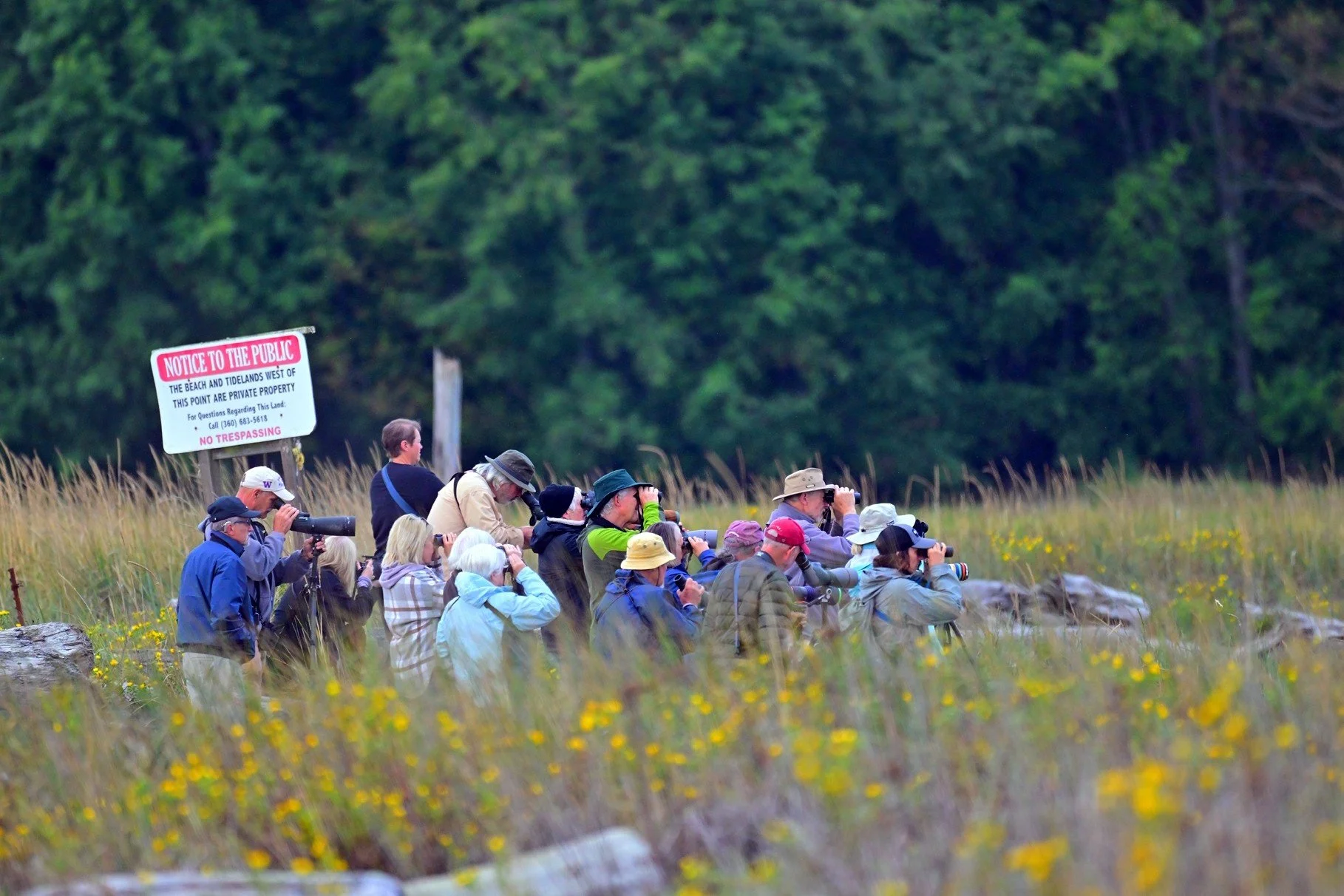
Birders at Dungeness Bay—Photo: Dow Lambert
Birdwatching Is Good for Your Brain
Good news for every member who has ever squinted through binoculars at a little brown bird: new research suggests our favorite pastime may help keep our brains sharp as we age.
In October 2026, BBC Future published a feature titled Birdwatching rewires the brain and slows cognitive decline. It pulls together brain-scan research from Canada and a large care- home project from Germany. Both point the same hopeful direction, though the scientists are careful about what they can and cannot yet prove. You can read the full article here: BBC Future: Birdwatching rewires the brain and slows cognitive decline.
A tip on access: BBC sometimes shows a paywall or sign-up prompt to U.S. readers. If that happens, try the link again later, or use the other free articles listed at the end of this piece.
What the brain scans showed
Expert birders had more tightly organized brain tissue in the areas we use to pay attention and recognize what we see. The study, led by neuroscientist Dr. Erik Wing at Baycrest’s Rotman Research Institute in Toronto, was published in the Journal of Neuroscience in early 2026.
Who took part: 58 adults, half expert birders and half beginners. The experts ranged in age from 24 to 75, and many were members of the Toronto Ornithological Club and Ontario Field Ornithologists. Expertise was judged by a bird identification test, not by years in the field.
What was measured: Participants identified local and unfamiliar bird species while inside an MRI scanner. The scans tracked how freely water moves through brain tissue. Less movement suggests denser, better-organized tissue.
What was found: Experts had more compact tissue in regions for attention, visual perception and short-term memory, and the experts with the most compact tissue identified birds most accurately. When experts faced unfamiliar, out-of-area birds, those same regions worked harder.
The finding that matters most for us: Brain tissue normally becomes less organized with age. That decline showed up in both groups, but it was gentler in the experts. Dr. Wing’s team says learning birding skills could benefit thinking as people get older.
Why birding? The researchers note it asks a lot of the brain at once: spotting movement, telling look-alike species apart, recognizing songs, and recalling what you know, all while outdoors. Follow-up work found that older expert birders also remembered unfamiliar faces better when the faces were paired with birds.
Bird feeders in nursing homes
You don’t have to be an expert, or even leave the building, to benefit. The BBC article also describes a German project led by Professor Elisabeth Kals of the Catholic University of Eichstätt-Ingolstadt, working with the Bavarian bird conservation group LBV.
Starting in 2017, the team set up bird feeding stations outside 65 nursing homes so residents could watch birds from indoor common rooms.
More than 1,500 residents took part, averaging 83 years old and including people living with dementia.
Residents’ memory, concentration, mobility, bird knowledge and life satisfaction rose over the months of the project. The BBC reports that improvements appeared within a few weeks, and that after a month birdwatching predicted residents’ wellbeing better than their age or level of care did.
The results were convincing enough that German health insurers have since helped fund feeders and viewing areas in more than 400 nursing homes in Bavaria.
The BBC piece also visits a birding group at Forge Mill Lake in England, where a participant living with dementia became noticeably more engaged while watching birds alongside others. The researchers suggest birds help because they bring novelty and spark curiosity, which stimulates the brain’s reward and alertness systems.
The bigger picture: 196 studies on birds and health
The brain-scan and care-home studies are part of a much larger body of research. In August 2026, a team led by Matthew Browning of Clemson University’s Virtual Reality & Nature Lab published the broadest review yet of how birds affect human health, in the journal Frontiers in Bird Science. They sorted through more than 26,000 records and kept 196 studies from 54 countries, covering about 1.2 million people. Older adults were the focus of 84 of those studies.
Strongest evidence: birdwatching, living in places rich in birds, and listening to birdsong had the most studies linking them to better mental health and well-being.
More than mood: birdsong was also tied to sharper thinking and to physical measures such as heart rate. Birding was linked to feeling closer to nature and caring more for the environment.
Even indoors: watching birds on video, reading about them and caring for pet birds were also linked to better well-being. The authors suggest window feeders and birdsong for care homes and hospitals, where getting outside isn’t easy.
Few downsides reported: only 7 findings pointed to harm, and none of them came from controlled experiments.
The authors are careful, too. Half the studies had no comparison group, and the review did not look for possible downsides, so the overall picture may lean positive.
A word of caution
None of this proves that birdwatching prevents or treats dementia, and the researchers say so themselves. The Toronto study was small and looked at people at a single moment rather than following them over years. It is possible that people who already have sharp attention are simply more drawn to birding and more likely to stick with it.
Outside experts also point out that birding bundles together several things already known to help the brain: walking, time in nature and time with friends. Professor Martin Sliwinski of Penn State told BBC Science Focus that activities likely need to stay challenging to benefit thinking, and birding does, because you can never quite go on autopilot. The next step, researchers say, is to follow beginners over time as they become experts.
What this means for us
The message is encouraging: keep learning, keep looking, and keep doing it together.
Keep challenging yourself. Learn a few new songs or calls each season, work on tricky groups like sparrows or fall warblers, or bird somewhere new.
Bird with others. In an interview with Audubon, Dr. Wing suggested birding with friends or groups, since other people notice things you might miss and stretch your attention.
No hike required. A feeder outside a window counts, as the nursing-home research shows. To keep birds safe, hang feeders within 3 feet of the glass or more than 30 feet away; in between, a startled bird can hit the window at full speed. Joining Project FeederWatch this winter is a good way to make backyard watching more focused.
Enjoy the extras. Fresh air, gentle walking and good company all do your brain good on their own.
We hope to see you on an upcoming chapter bird walk or field trip. Bring a friend, and let’s keep our brains as busy as the birds we watch.
Read more
BBC Future: Birdwatching rewires the brain and slows cognitive decline (October 2026)
NBC News: How being an expert birdwatcher may boost cognition
BBC Wildlife (Discover Wildlife): Birdwatching may slow ageing of the brain
Earth.com: Expert birders develop lasting brain changes that resist aging
Browning et al., Frontiers in Bird Science (2026): The human health and well-being benefits of birds
The original study, Wing et al., Journal of Neuroscience (2026)
Zieris, Freund & Kals, Journal of Environmental Psychology (2023): bird watching in nursing homes
Melonie Ramsey Co-Vice President
Olympic Peninsula Audubon Society Copyright 2026; All Rights Reserved