
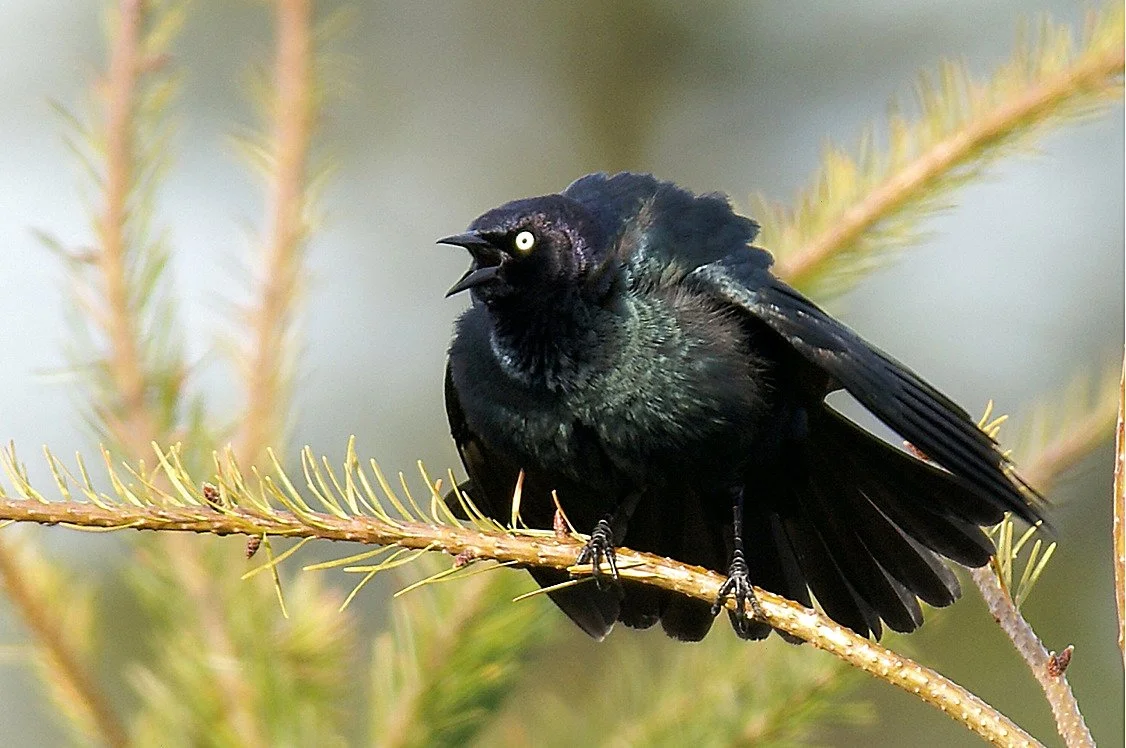
Brewer’s Blackbird—Photo: Dow Lambert
Parking Lot Birding
By Jane Nicholas and Ida Domazlicky
By the time you read this, the wet, dark days of winter will have taken hold. This doesn’t mean we have to give up birding if we get creative. While thinking about this month’s article, I remembered a professional bird photographer saying that a car makes a great shooting blind, especially in places where birds are used to vehicles. He shared that one of his favorite bird photographs was taken outside a fast-food restaurant. Rain or shine, hot or cold, you can usually find birds hanging out in parking lots like teenagers on a Friday night. Locally, Three Crabs, John Wayne Marina, Dungeness Landing, Home Depot, and McDonald’s come to mind. It doesn’t take a lot of time, and it can be peaceful to sit in your car for a few extra minutes while you’re out and about. You might spot a variety of gulls, American Crows, or one of my favorites—Brewer’s Blackbirds.
Male and female Brewer’s Blackbird. Photo: Jane Nicolas
In April of 2016, I was still living in Missouri. While birding at a local park, I spotted an apparent pair of birds that were unfamiliar to me. They were about the size of an American Robin. One was black with a purplish iridescent head, a longish tail, and surprising yellow eyes; the other was plain brown with dark eyes. Come to find out, they were male and female Brewer’s Blackbirds. The flashier one was the male, which is usually the case. In Missouri, they are “uncommon” except briefly during migration, so I was really excited to add them to my life list. Then in July, I moved to Sequim. I went to Home Depot for carpet shampoo and was amazed to find a whole flock of Brewer’s Blackbirds sashaying around the parking lot! They can be found there most days in good numbers, though some people seem to find them annoying instead of special: “Get out of the way. I’m trying to park here!” I’ve had the following conversation with my husband as I slowed down to let them pass: “You know they can fly, don’t you?!” he asks. “Of course,” I reply, “but it seems rude to rush them when they look so happy hopping around looking for treats.”
In addition to providing entertainment in parking lots, Brewer’s Blackbirds are a truly interesting species. While the populations of many songbirds have been greatly reduced due to habitat loss and other tribulations, Brewer’s Blackbirds are holding their own. Why? Adaptability. These birds are at home in a wide variety of habitats, from coastal scrub to sagebrush, and from sea level to 8,000 feet. Their diet is also flexible, consisting of seeds, grains, and insects—plus they will eat almost anything left lying on the ground, even if it’s bad for them (hence the draw of parking lots). They will forage on concrete, yet they can also play hopscotch on lily pads while searching for live prey in secluded ponds. Brewer’s Blackbirds have taken what could be disadvantages for other species in stride and have even turned them to their advantage.
They aren’t picky about nest sites either, choosing low shrubs one year and treetops the next. A few female scouts search for a new site to start their twig-and-mud nests, and the rest of the flock follows their lead. They mold a shallow cup nest that holds three to seven eggs. Sometimes the same pairs reunite year after year, though they don’t hang out together after nesting season. Guard birds warn the colony of predators and will even dive on and strike much larger birds, such as hawks or owls. They also migrate in a leapfrog pattern, meaning the birds we see here in winter may have traveled from farther north as our summer birds fly south.
While Brewer’s Blackbirds are common enough here that we often take them for granted, they are an interesting and resilient species that deserves a special place in our hearts. I hope you can get out and enjoy birding from your car this winter—it’s a great way to beat the winter blahs. Don’t forget your binoculars, though be aware that some folks might wonder what you’re up to!