
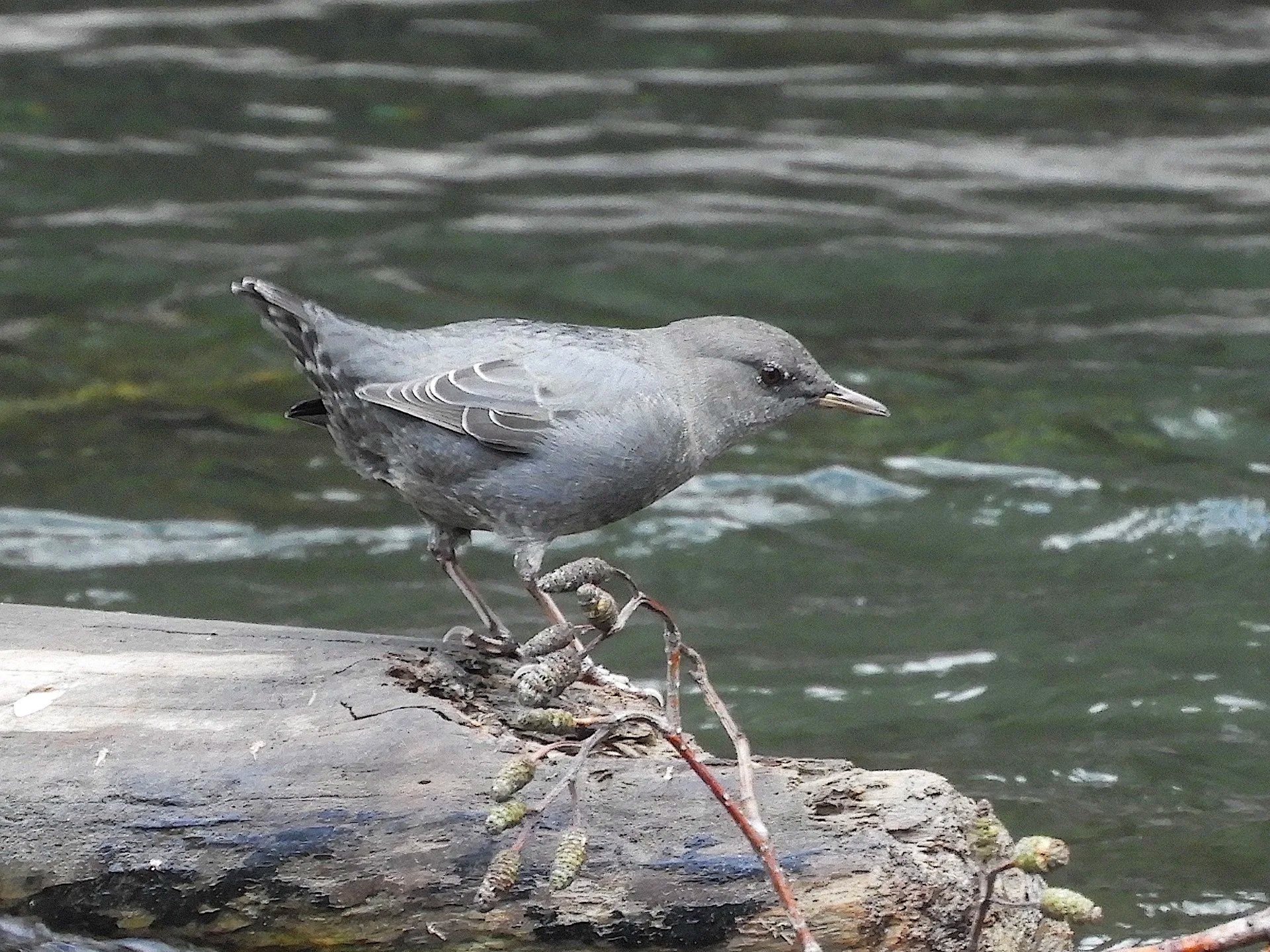
American Dipper—Photo: Bob Boekelheide
October President’s Notes: A House Divided Will Fail—Death by a Thousand Cuts
by Matt McCoy

In the distant past, when I was studying to become a junior wildlife biologist, among the most important lessons we learned were what animals need to survive and how natural resource management evolved to provide them. The four basic requirements for wildlife survival are simple: food, water, cover, and space. Like us, they need a home and everything that goes with it. When our pantry is empty, our water stops running, or our roof blows away, we can usually resolve these issues: go shopping, call a plumber, or find temporary housing until repairs are completed. That works well in our world of abundance and redundancy.
Wildlife don’t have those luxuries. When a clearcut eliminates woodpecker nesting and foraging habitat, they can’t just move to a nearby stand; that territory is already occupied (just like we can’t take over our neighbor’s house when ours is uninhabitable). If insect food sources are reduced or eliminated by pesticides, there are no replacement food sources. If drought or human uses dewater a creek, there is no bottled water available for a dipper or a salmon to tide them over. Wildlife won’t survive if basic requirements are removed.
Post‑colonial resource use was aptly described as the “Tragedy of the Commons” in a 1968 Garrett Hardin essay. His basic premise was that unfettered individual use of shared resources will ultimately exhaust them. Through time, our nation came to realize that natural resources were not unlimited, and their unmanaged exploitation was not sustainable. It took decades of hard‑fought battles to develop our current management and conservation frameworks. Key wildlife elements included addressing illegal wildlife trade, protecting migratory birds, providing funding for management activities, and ensuring species survival. Creating public land management agencies and providing measures to protect resource quality ensured wildlife would have suitable places to live.
Unfortunately, these basic lessons are being ignored and protections reversed on almost every front at the national level. The administration has seemingly left no stone unturned in its quest to deregulate and unleash resource exploitation. Two recent examples include proposed changes to endangered species and roadless area management.
The 1973 Endangered Species Act has been a cornerstone for species protection and recovery. Prior to this year, the regulations implementing the act included habitat modification or degradation that significantly impaired breeding, feeding, or sheltering as a prohibited “take” of a protected species. It recognized that a species cannot survive without habitat. The “take” definition was recently modified to include only death, injury, or removal of protected species. Habitat destruction would only be considered a “take” if a protected species was killed during the action. Not satisfied with that narrow definition, the administration is proposing that “take” would only apply if the instigator knowingly and willfully killed a protected species—a few seemingly small changes that significantly weaken the law.
The 2001 Roadless Rule was implemented to protect undisturbed ecosystems and prevent the need for road maintenance on one‑third of Forest Service lands. The rule doesn’t prevent roadbuilding; it just limits it. Using the specious argument that roads will improve forest health and reduce wildfire risk, the administration is proposing to rescind the rule. The 380,000 miles of roads on the two‑thirds of Forest Service lands unaffected by the rule have had minimal forest health or wildfire control benefits. The Tongass National Forest, one of the largest areas covered by the rule, does not have forest health or wildfire risk issues. Here on the Olympic Peninsula, roadless areas within the Sol Duc, South Fork Skokomish, and Queets watersheds on Olympic National Forest lands protect some of the last remaining low-elevation old‑growth habitat for Northern Spotted Owls, Marbled Murrelets, and salmon, safeguarding vital river corridors directly downstream from their protected National Park headwaters. Removing those protections would accelerate fragmentation, increase disturbance, and degrade water quality in already stressed watersheds.
The administration’s unrelenting assault on our natural world may make us feel helpless. But we are not. We care about wildlife and must raise our voices on their behalf. Your Audubon chapter regularly joins other groups in commenting on and opposing these actions. You can help by writing representatives, weighing in on proposed changes, and supporting organizations that challenge these actions in court and elsewhere. Together, we can make a difference.