
Birders Pamela Jennings and Bill Baker during the SDCBC—Photo: Bob Boekelheide
December President’s Notes—‘Tis the Season
by Matt McCoy

It’s the season for Audubon Christmas Bird Counts (CBCs)! The National Audubon Society is celebrating its 126th year of counting birds during the holidays—one of the longest-running community science projects.
Back in 1900, ornithologist Frank Chapman proposed counting birds on Christmas Day instead of hunting them. That first year, 27 people at 25 locations across North America tallied 89 species and about 18,500 birds. From those humble beginnings, the CBC has blossomed into a global tradition.
During the most recent season (December 14, 2023–January 5, 2024), volunteers conducted 2,677 counts across Canada, the United States, Latin America, the Caribbean, and Pacific Islands. Together, 83,186 participants recorded 2,380 species and 40,871,030 individual birds. Are you among them?
I participated in my first CBC in 1987. My Boise neighbors, avid birders and Auduboners, thought that if I called myself a wildlife biologist, I should act like one and count birds. Never mind that my birding skills were limited to an ornithology class and associated field trips in the early 80s. That’s the beauty of a CBC, anyone can participate. My count mentor was patient, repeatedly verifying that it was yet another robin I had brought to his attention. At least I could take notes, count past two (although not very well), and read a map. We were fortunate to cover an area with little development at the time—something that changed dramatically as Boise grew, so there was plenty of walking and habitats to explore beyond houses and streets. It was my first real Audubon experience, and they had their hooks in me.
CBCs soon became an annual tradition for me, with opportunities to join multiple counts across southwest Idaho. The Bruneau count quickly became my favorite. The “sprawling metropolis” of Bruneau—population 190—is both the count’s namesake and its only community within the circle. That means lots of wide-open spaces with C. J. Strike Reservoir running through the heart and the Morley Nelson Snake River Birds of Prey National Conservation Area surrounding much of the reservoir.
In the early days of the count, there were as few as three to five participants. Our morning was spent thrashing through the Bruneau Marsh, stepladder in tow, checking out Screech Owl nest boxes and tallying anything else that stirred in the tangled vegetation. Somehow, we found our vehicle again and hit the roads for the remainder of the day, interspersed with short hikes at particularly promising sites. You never know what memorable birds you might see, but they stick with you. If you saw 15 Rough-legged Hawks on wheel-lines in an alfalfa field one year, you expected them every year. That field that had eight raptor species and a fox, surely, they’d all be there again.
The Bruneau count organizer believed that if you wanted to do community science you’d show up regardless. If count day landed on January 1, all the better. Serious birders weren’t out drinking the night before and certainly didn’t waste time watching football. If it was -35 degrees out, well that built character (unfortunately the poor Horned Larks trying to warm up on the highway would have preferred if we’d stayed home). After the last Common Goldeneye was tallied flying upriver in the dark to overnight on the reservoir, there was still an hour-and-a-half drive home—under ideal road conditions. At least it gave us time to thaw out, if the heater worked.
Beyond the love of birds, there are many reasons why so many people participate. There’s the joy of sharing time with like-minded folks and knowing you’re part of something much bigger. Counts are often the only chance to reconnect with birding friends you may not see otherwise. Morning people no doubt relish the thought of seeing non-morning types drag themselves in through the dark and cold for the early morning kickoff meeting and area assignments. Hardy people no doubt feel a little smug listening to fair weather types complain about the conditions.
I was lured in by the prospect of free donuts and a chance to make friendly wagers on who would spot the most species. Then there’s the opportunity to get out for a full day of birding in the name of science. Meeting my future wife on a Bruneau count was an unexpected bonus, though at the time, she questioned my preoccupation with cows and All-Day-Dave’s choice of cowboy music for the slow trip home on icy roads.
I hope you take the opportunity to join one of our Olympic Peninsula counts if you haven’t already.
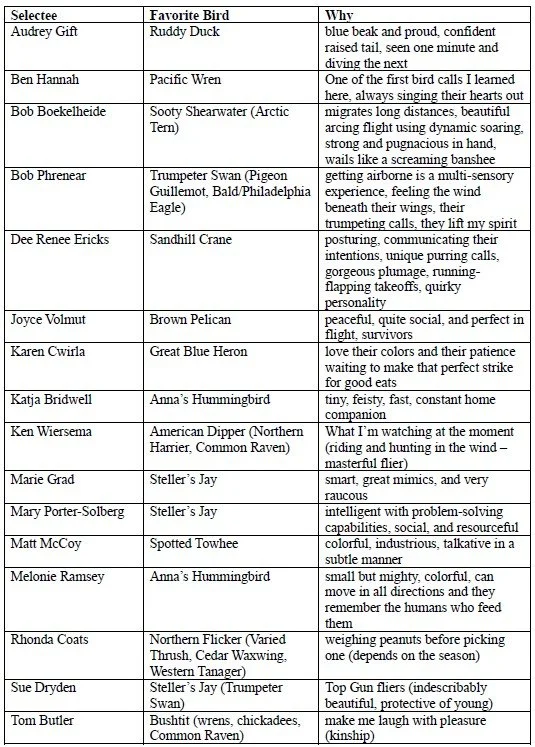
For those of you who took the favorite bird challenge and have been on the edge of your seats since, here are the results including what’s so appealing about their bird in their own words. Steller’s Jays and Anna’s Hummingbirds were the most favored. Alternative choices (depending on time of year, locale, or…) are listed in parentheses for those who had trouble deciding.