
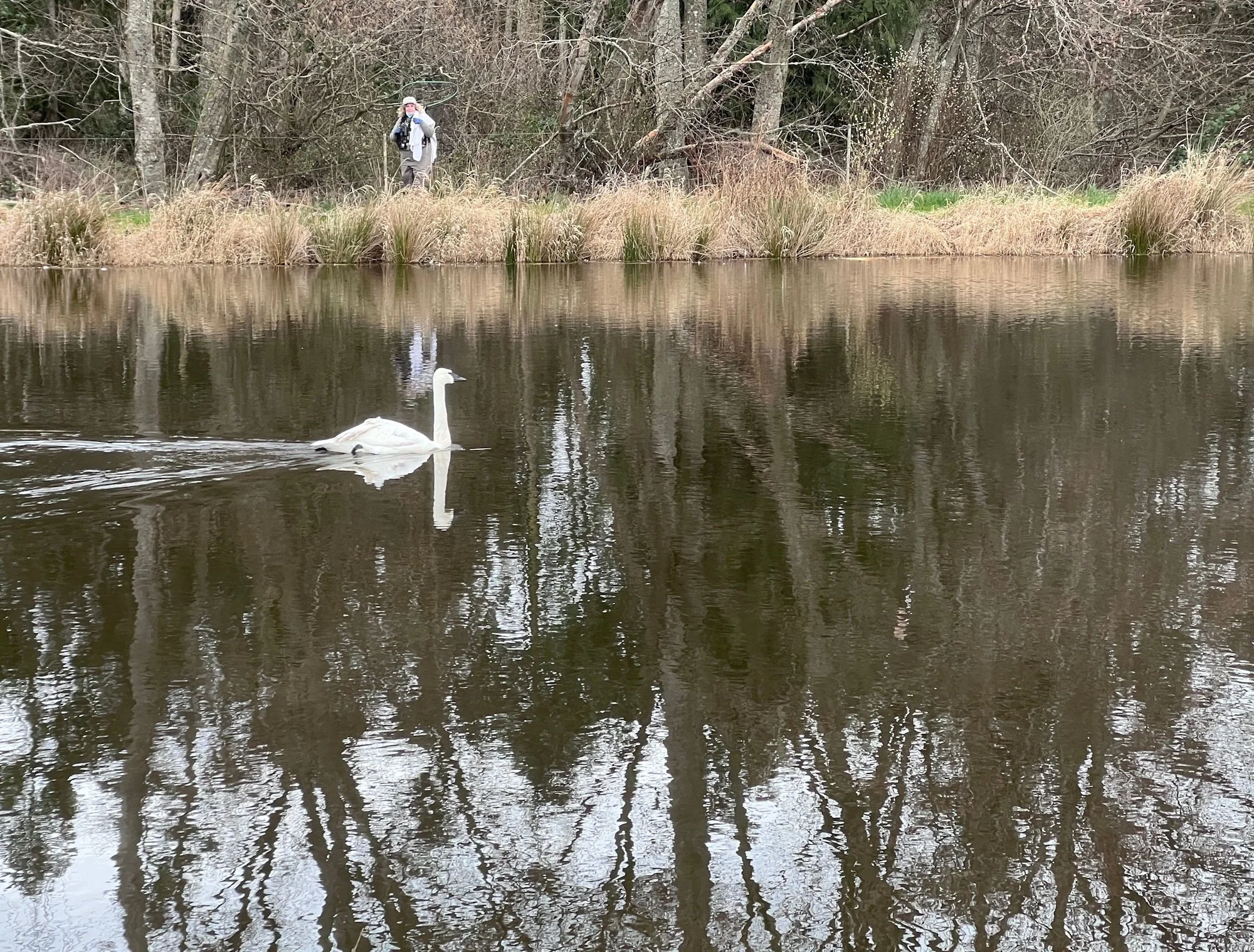
Shelly Ament assesses the condition of an adult Trumpeter Swan—Photo: Laura Davis
March 2026
Shelly Ament: A Legacy of Swan Stewardship in Clallam County
by Bob Phreaner

(Note: The month of Shelly’s retirement has been updated for accuracy from the newsletter version.)
Shelly Ament will retire May 31, 2026 from her position as the Washington Department of Fish and Wildlife Biologist for Clallam County. For more than 25 years, she has been the person the OPAS Conservation Committee turns to whenever questions arise about wildlife management—especially incidents involving our wintering swan population.
Our OPAS swan project began out of concern for lead poisoning. In 2014, Shelly asked me to help capture swans that had ingested lead shot in the Meadowbrook Creek tidelands and other ponds. Those early experiences led to a deeper understanding of the threats facing our local Trumpeter Swans.
It was Shelly who first told me about swans colliding with the power lines at Kirner Pond, and that Martha Jordan and the Northwest Swan Conservation Association were looking for ways to prevent these collisions.
I began visiting Kirner Pond regularly in 2016, and by the winter of 2017–18, I was out there at dawn almost every day from November through March when swans roost on the pond. After a year or so of observations, a pattern became clear: collisions were most likely on calm, overcast mornings, when the lack of headwind made it harder for North America’s heaviest flying bird to gain lift.
I started filming swan takeoffs to document the danger posed by the power lines and captured many near‑misses and injuries. I could call Shelly any day of the week, and she always responded. On December 9, 2020—another calm, overcast morning—the trailing swan in a group of four or five struck two thin distribution wires and was electrocuted. Shelly arrived within 20 minutes, even though it was well before her workday began.
Shelly Ament with electrocuted Trumpeter Swan
We reported the incident to the PUD, and Mike Hill and his crew responded the next day, December 10, by installing dozens of diverters in the swans’ flight path. We knew this would help but would not eliminate the risk; the swans would continue trying to clear the lines at their favored roosting pond.
Neighbors along Kirner Road were also calling the PUD, urging action to address the danger to the swans.
Shelly mentioned the situation to Martha Jordan, who happened to be working with videographer John Gussman in the Skagit. John came to Kirner Pond, witnessed a collision while we were discussing possible solutions, and agreed that a campaign to raise funds to bury the distribution lines might be feasible. He filmed me at the pond explaining the need for line burial, and a few days later we recorded Shelly’s testimony. The resulting production became the Sudden Death video, which Shelly has since shown at wildlife and electric‑utility conferences across the region.
The PUD still needed convincing. The cost was a major obstacle. PUD projects fall into two categories: “capital projects,” which the utility funds to improve its services, and “customer projects,” which must be paid for by the customer. We proposed that the swans themselves be considered the “customer.” I informed the OPAS Conservation Committee and the OPAS Board, and we launched a GoFundMe campaign. Within two months, OPAS and the community raised $65,000—more than enough to fund the project.
Shelly then began working with the neighbors whose properties the buried lines would cross. Some were hesitant, but Shelly’s steady, thoughtful approach won them over.
Many others contributed along the way, including technical advisors and community partners, but it was Shelly’s persistence and leadership that kept the project moving forward.
Since the power lines at Kirner Pond were buried in August 2021, there have been no further swan collisions at this important roost. Unfortunately, we have had one electrocution on Cook Road during the 2025–26 season that will require mitigation soon. Even in her final weeks with WDFW, Shelly is already working on the issue.