
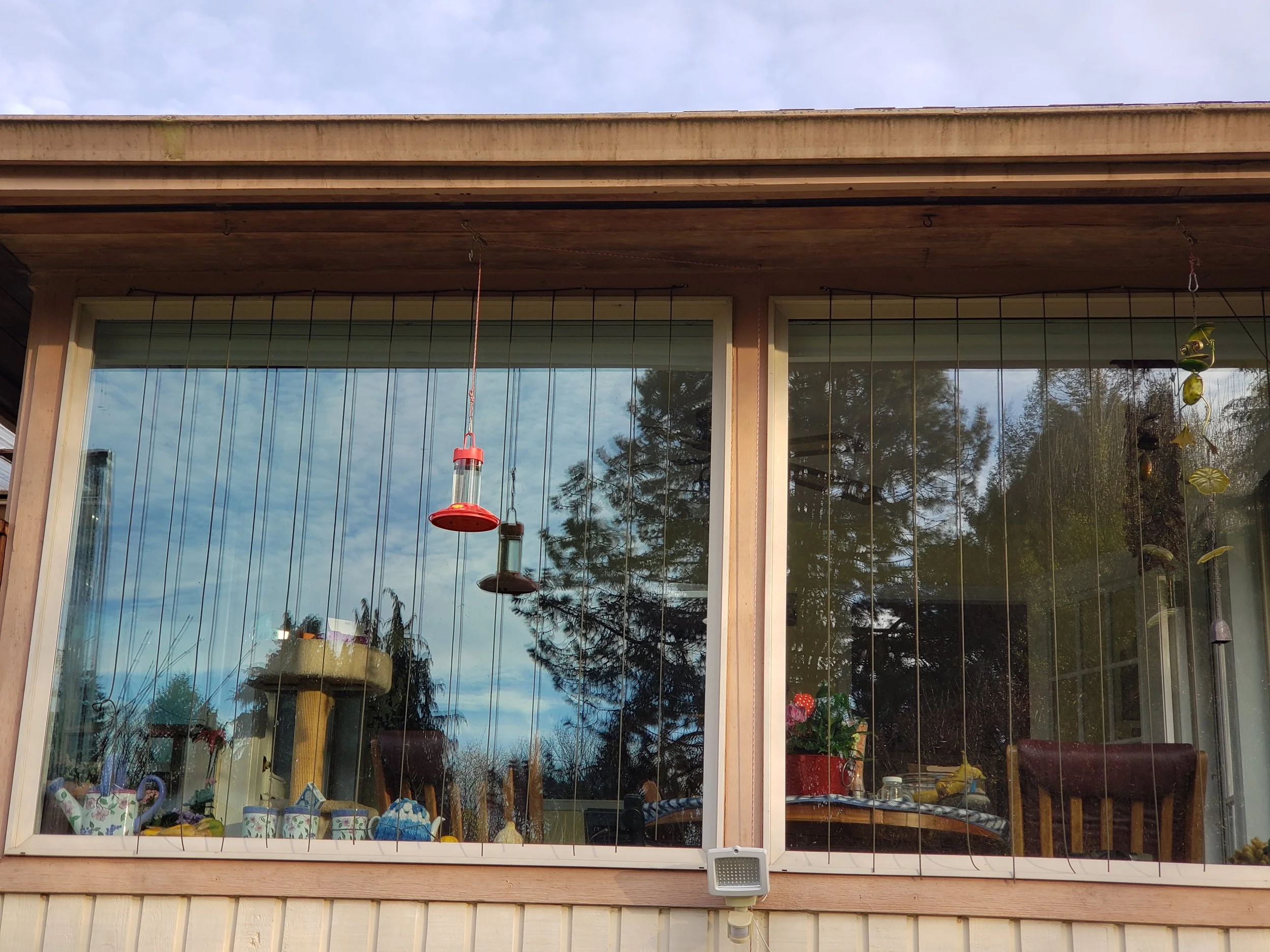
Acopian BirdSaver cords on window—Photo: Dee Renee Ericks
November—December 2021
Reduce Window Strikes: What works and what doesn’t
by Dee Renee Ericks

Here are some practical, do-it-yourself tips for limiting bird collisions on your home windows. Many of these suggestions can be applied at little or no cost.
We know that birds strike windows for several reasons, primarily the transparent and reflective qualities of glass. Other reasons include:
Birds believe they are on a safe flight path because they see the landscape around them reflected from the glass.
They see through the window to habitat, either inside your home or through to the other side, and don’t perceive the glass as a barrier.
They see their own reflection in the glass and attack the window. Territorial aggression can result in bill injuries.
Here are some simple modifications you can easily make to minimize injury to birds:
Move feeders close to your windows (1.5 to 3 feet), or use window feeders. From that distance the birds can’t build up enough momentum to hurt themselves if they hit the glass. Otherwise, feeders should be placed at least 30 feet away.
Close blinds, curtains, or shades to break up window reflections of habitat, or the illusion of a clear passage.
Move houseplants away from windows.
Create markings on the EXTERIOR portion of windows to eliminate or break up window reflections. Make the openings so small that birds think they can’t fly through.
What Works!
Any portion of a window reflection, larger than 4” wide or 2” high, presents a possible flight path. FLAP Canada recommends that marker spacing be no more than 2” X 2”. Window markings need to stand out in contrast to the glass in varying light conditions. Markers should be no less than ¼” thick. The entire exterior glass surface should be covered. Examples:
Markings with a soap bar
Use of Tempera paint designs (using stencils are fun!)
Artwork or designs using a broad tipped oil based Sharpie pen in white. It’s removable with acetone to a cotton ball or pad. Lightly dab the affected surface to dissolve the paint marking. Also isopropyl alcohol, or rubbing alcohol works too!
Exterior screens
What does NOT work!
Falcon Silhouettes
Bird decals
Netting (entanglement issues)
Plastic Owls
Remove Unnecessary Lighting:
To minimize nighttime bird collisions with glass or buildings, reduce nighttime lighting! Ideally, turn off all light sources between dusk and dawn, especially during migration season from mid-February to the end of May and from mid-August to the end of November.
Control when and where light shines by:
Using light fixtures that are shielded, instead of globe-type models that spew light everywhere.
Choosing downlighting over uplighting to keep from directing light into the night sky.
Using motion sensors to avoid steady-burning lights, and timers to ensure that lights aren’t left on longer than necessary.
Controlling the color of the light. When it comes to the effects of light on birds, not all wavelengths are created equal. Red light and white light disrupt birds’ geomagnetic orientation. Blue and green contain less long-wavelength radiation and are much less disorienting.
Close shades, drapes and blinds.
For further information, check out OPAS’ Project BirdSafe.