
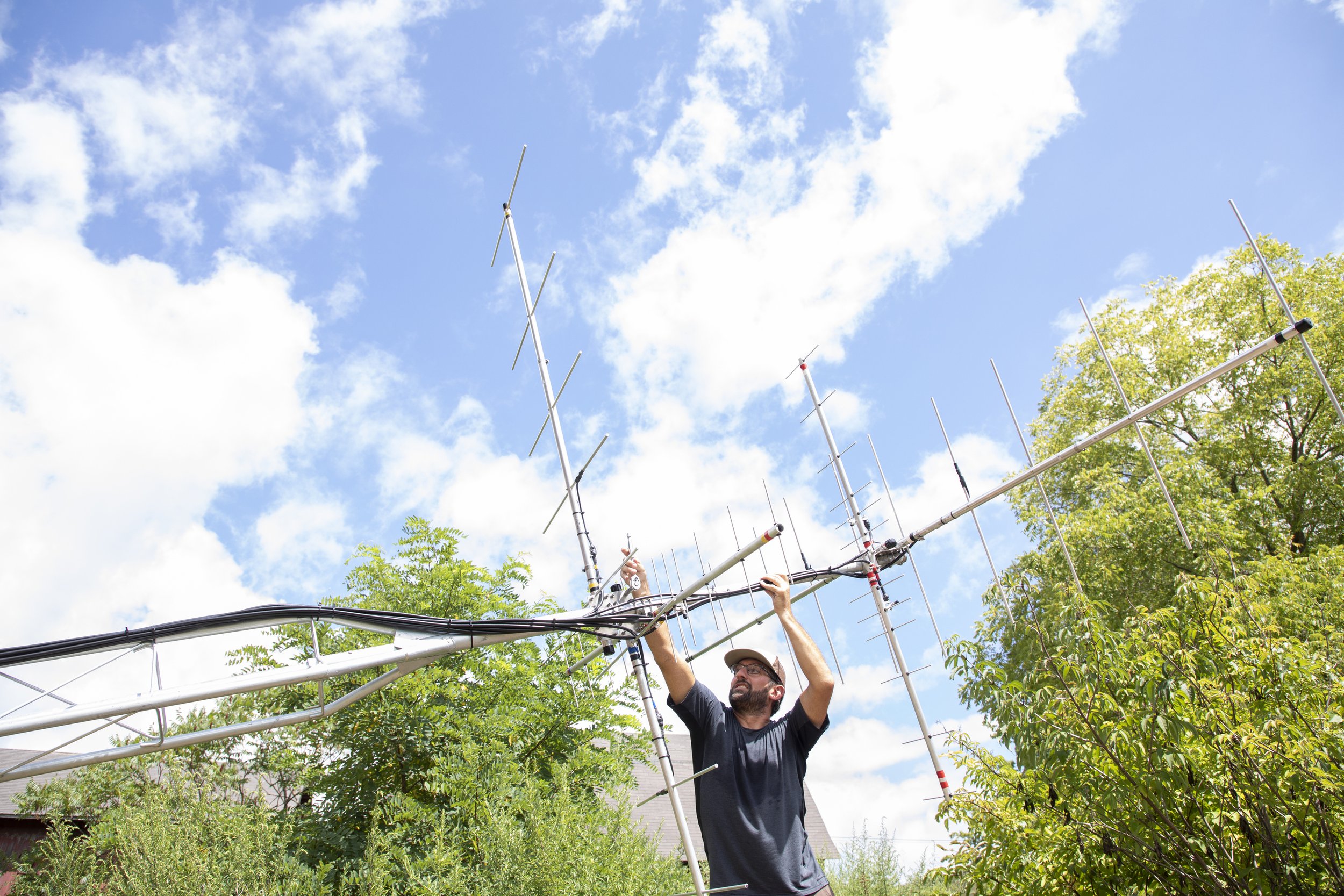
Motus installation—Photo: Luke Franke/Audubon
July—August 2022
Motus Wildlife Tracking System
by Bob Phreaner
The Motus Wildlife Tracking System is a program of Birds Canada in partnership with collaborating researchers and organizations. Motus uses coordinated radio telemetry to learn about the ecology and conservation of migratory animals. Tiny radio-transmitter tags can be glued to the back of birds and the signal can be detected by receivers distributed about the landscape. Each tag emits a unique signature so we can determine where animals go, how fast they transit between points, and how long they stay in an area. This information can be used to support conservation of stop-over sites, leverage public engagement for funding, and encourage preservation of these crucial areas in a time when bird populations are in decline.
Motus has been used extensively in New England as well as Canada to track bird migration patterns and recently it is expanding to the Pacific Flyway. In British Columbia, Motus sites such as Robert’s Bank in the Fraser River Delta are used to monitor how Western Sandpipers (WESA) move through the Salish Sea. Recent data suggests that WESA counts fluctuate with salinity. Floods lower the salinity and decrease the quality of diatoms available to support the migrating WESA. In these conditions observers see a decrease in the duration of the stop-over and a decline in the seasonal count of WESA.
On June 8, I attended a virtual meeting on the expansion of Motus receiver sites into Washington State. At this time the US Fish and Wildlife Service has receivers in the Nisqually Delta, Tokeland, Oysterville and at Brekenridge Bluff. You can learn more at USFWS Shorebird Project, at https://motus.org/data/project?id=337. Kitsap (Point No Point) and Whidbey Audubon as well as the Samish Indian Nation are planning for receiver sites too.
How about the Olympic Peninsula? This might be an opportunity for a new Community Science project. There is much to learn about this technology such as the battery life of the transmitters, the optimal locations of receivers, and expense of maintaining this equipment. OPAS Conservation Committee volunteers are interested in following up on these developments. You can visit the motus.org website for more information.