
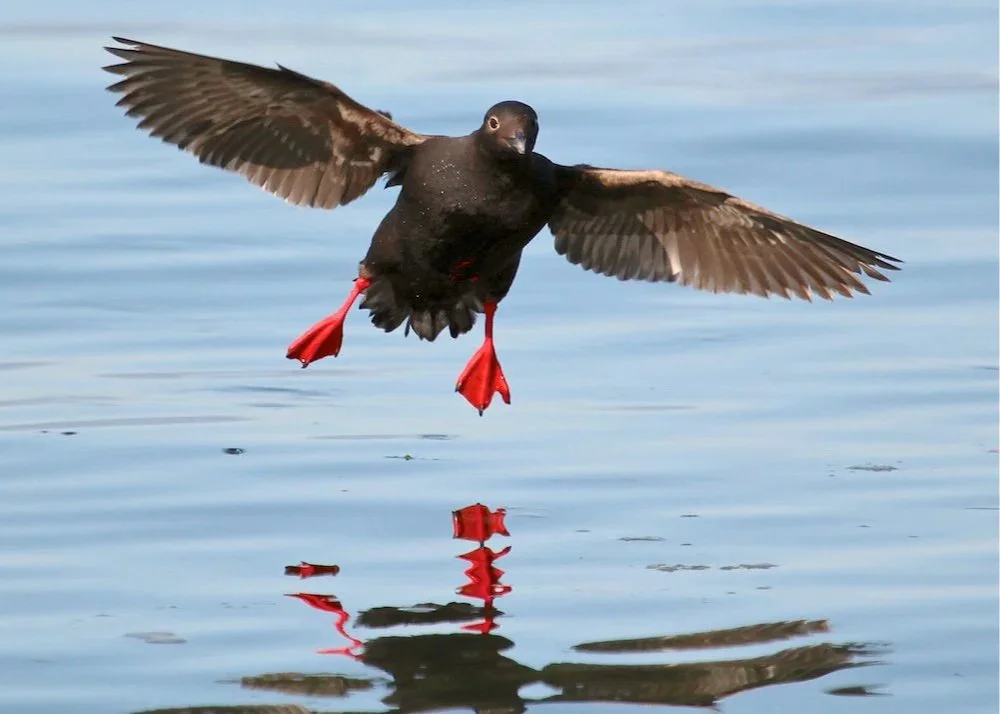
Pigeon Guillemot—Photo: Govinda Rosling/Audubon Photography Awards
July—August 2023
How and Why we Watch Pigeon Guillemots
by Bob Phreaner, Conservation Co-Chair

Pigeon Guillemots (Cephus columba) aka PIGU are considered an indicator species of the health of coastal ecosystems in the Salish Sea.
In 2004, Whidbey Audubon community scientists started monitoring PIGU breeding and population numbers. Ed Bowlby and Mary Sue Brancato started a pilot monitoring effort at Port Williams bluff in 2015 that was successful enough to engage Clallam County Marine Resources Committee (MRC) and OPAS to survey Clallam Pigeon Guillemots in 2016. Many of the OPAS volunteers have been monitoring the same locations for eight years. In 2022 Jefferson County joined the survey which now includes most of Puget Sound.
Every Tuesday morning from June through late August, about a dozen trained volunteers meet at Port Williams ramp at 6:45 a.m. to walk as a group heading north along the bluff, deploying an observer at locations with PIGU burrows until the beach is totally covered to monitor PIGU activity between 7 and 8:00 a.m.
Pigeon Guillemots at Port Williams Beach—Photo: Bob Phreaner
The observer remains quiet and motionless on their beach chair positioned so that they can observe the bluff and the surf. We study the behavior of the nearshore Pigeon Guillemots with binoculars and note if the birds are carrying fish like gunnels in their beaks. The location of each burrow is mapped and a record of PIGU visits to burrows is kept by each observer. The records are entered into the data system weekly and the regional monitoring data are being utilized by the Washington Department of Fish and Wildlife, the University of Washington, and individual counties. Click on this link to the Salish Sea Guillemot Network (SSGN) to learn why we study Pigeon Guillemots.
Read the latest report from Scott Pearson at WDFW on Puget Sound Indicators, Abundance of Marine Bird Populations which includes Pigeon Guillemots as one of four Marine Bird Vital Sign Species. This is based on population estimates from aerial surveys and also considers population data obtained from SSGN.
In June most of the visits of the birds to the burrows will be to change partners sitting on eggs. By July we record an increase in the number of Pigeon Guillemots carrying fish to their growing chicks.
After eight years as an observer at Port Williams I can testify that watching the charismatic red-footed PIGU ranges from relaxing to comical to hectic. Some mornings early in the season have little activity and you can photograph the PIGU courting and mating. Later in the summer your head is on a swivel to record every food delivery by multiple birds to different burrows simultaneously. This experience of watching the behavior of Pigeon Guillemots at short range has increased my interest for close up observation of other seabirds like Tufted Puffins and Rhinoceros Auklets, if only there were such an opportunity in Clallam County. I can dream.
Maria Mudd Ruth who spoke to OPAS about her book Rare Bird: Pursuing the Mystery of the Marbled Murrelet is writing a full natural history of guillemot from multiple perspectives now scheduled to be released by Mountaineers Books next Spring which will be essential reading for PIGU observers.