
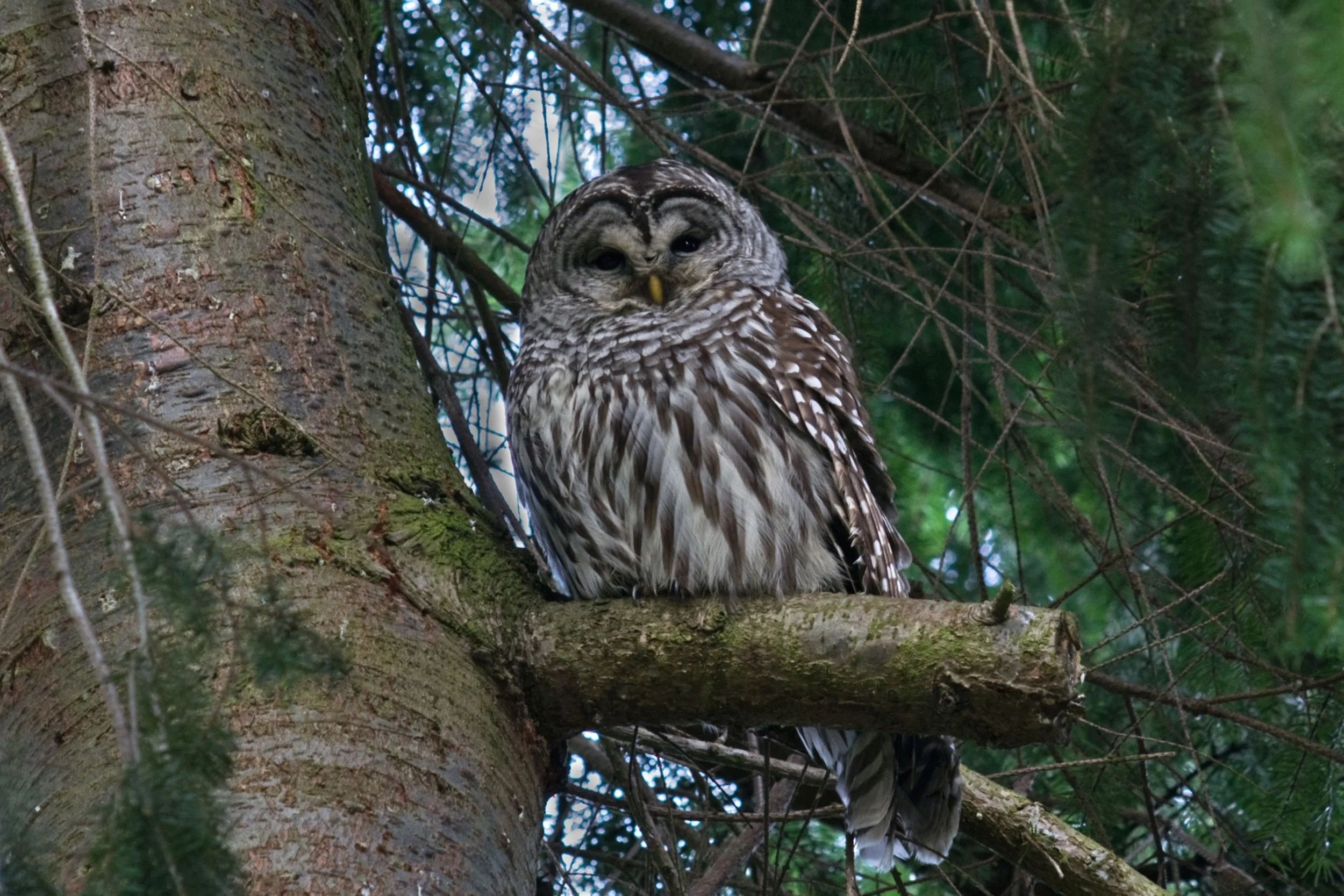
Barred Owl—Photo: Dow Lambert
January—February 2024
Barred Owl Management Strategy
by Bob Phreaner, Conservation Co-Chair

I am writing this column on the 50th anniversary of the Endangered Species Act (ESA). 99% of the over 1600 species listed for protection since 1973 have been rescued from extinction. The Bald Eagle and Peregrine Falcon have recovered enough to be delisted. In a 2022 research paper published in PlosOne, further success of the ESA has been limited by insufficient funding and waiting until species are already too far gone. Such might be the case for the Northern Spotted Owl (SPOW) which was listed in 1990. According to the USFWS data, SPOW have declined 35-80% in the over 20M acres of protected federal old growth forest habitat the owl depends on. The Northwest Forest Plan stopped all logging of old growth forest in 1994. In the Olympics the SPOW have declined 8% per year. Acoustic monitoring devices now detect the presence of SPOW in only 20 of the 120 polygons on the Olympic Peninsula. The primary stressors affecting the SPOW’s current biological status include past habitat loss, wildfire, and since 1972 the incursion of the nonnative Barred Owl (BADO) which has had the greatest impact. SPOW persist in the Olympics mostly in areas with the lowest BADO density. These are at higher elevation areas and at the backs of fjord-like valleys of habitat surrounded by high elevation ridges without forest. BADO populations are denser at lower elevations in more contiguous forests.
For the past 10 years the US Fish and Wildlife Service has conducted an experimental program at multiple locations including Cle Elum, WA where they eliminated Barred Owls. Removal of BADO within and around occupied Spotted Owl sites retained the existing SPOW population, increased the potential of their reproduction and could provide a source population for translocation of SPOW into habitat where the BADO management strategy is employed. The USFW is planning to begin permitting this BADO management strategy on the Olympic Peninsula in 2024. The Government of British Columbia is engaged in BADO management and SPOW reintroduction including captive breeding and translocation.
The US Fish and Wildlife Service Barred Owl Management Strategy and associated MBTA permit is intended to be a voluntary tool in efforts to reduce the impact of the BADO for the conservation of the SPOW.
The OPAS Conservation Committee submitted comments on the Barred Owl DEIS to the USFWS on June 6, 2012, which you can read by clicking this link or read below:
“The recovery of the spotted owl remains a high priority for our membership, but lethal control of barred owls continues to be a controversial issue which warrants a high level of assurance that the Service will endeavor to address the original reasons for the spotted owl decline and adequate protections are assured.
“After careful examination of the DEIS, OPAS has taken the position to support a controlled, experimental, removal of the barred owl in order to prevent the extinction of the spotted owl. Our decision is based on scientific data that indicates that direct competition from an influx of the more aggressive barred owls into the Pacific Northwest has created a nesting decline which makes spotted owl recovery potentially impossible.
“We support continued, full protection of barred owls under the Federal Migratory Bird Treaty Act of 1918, but are willing to concede to experimental removal only for the specific purpose of determining whether long-term lethal control of barred owls is warranted and practical. If the Service determines the experimental removal of barred owls is successful, it is important that all management strategies proposed in the DEIS are determined economically feasible.
“We believe the most important aspect of the recovery of the spotted owl continues to be adequate habitat protection of remaining old growth forests. The proposed Revised Critical Habitat Rule for the Northern Spotted Owl could potentially weaken the protections currently provided by the Northwest Forest Plan.”
The US Fish and Wildlife Service Barred Owl Management Strategy can be read here. You can also watch a 12/14/23 webinar explaining the program at that link. The comment period about this proposal closes 1/16/24. Prior to commenting it is important to read and understand the 300-page document which proposes controlled but desperate measures to save the iconic SPOW.