
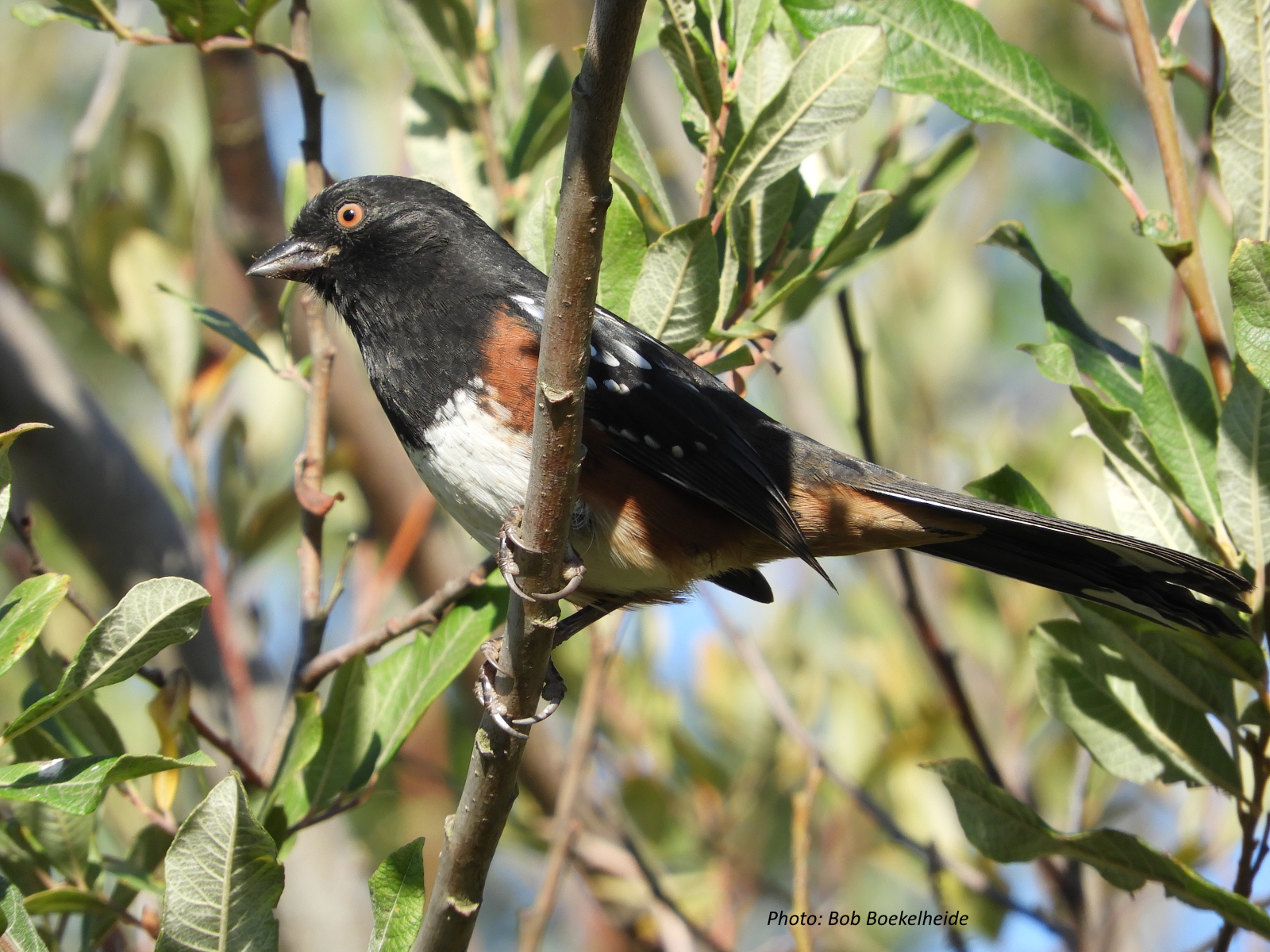
Spotted Towhee—Photo: Bob Boekelheide
Climate Watch Survey Begins May 15 - June 15, 2026
Volunteers Needed
by Joyce Volmut

Join the OPAS Climate Watch Program and help track how climate change is affecting the birds around you.
Birds have long been able to shift their ranges in response to weather, heat, food availability, or habitat loss. But with climate change accelerating, National Audubon set out to measure how well birds are adapting. In 2014, Audubon released Survival by Degrees, a landmark report showing that two‑thirds of North American bird species are at risk.
Since 2016, Climate Watch volunteers across the country have been collecting data that Audubon scientists use to understand how selected “target species” are responding to a warming climate.
Climate Watch occurs twice a year - to detect wintering ranges of birds (January 15- February 15) and to detect the breeding range (May 15 - June 15).
Anyone can join
If you can identify any of these birds—Western Bluebird, Red‑breasted Nuthatch, Spotted Towhee, American Goldfinch, or Lesser Goldfinch—by sight or sound, or if you’re eager to learn, you can participate. Join OPAS and help us survey how these species are already responding in our region.
It’s fun, flexible, and family‑friendly. You can start in your own backyard or choose up to 12 locations to survey. Just be sure the sites you select are places where the target birds are likely to occur.
How to Conduct a Climate Watch Survey
Click here to review Audubon’s 2-page Protocol
The protocol is simple:
Choose a location or multiple locations.
Count all the birds you see or hear within five minutes at each chosen location.
Record the birds counted at each location on a separate checklist on eBird or on a special tally sheet provided by the program, or you may use the Audubon app.
Return the tally sheets or share eBird check lists with me (joyce.volmut@gmail.com) so I can send the tallies to National Audubon. If you use the Audubon app, the checklist will go directly to them.
Record the start time and stop time for each survey location. Remember it cannot be over 5 minutes.
It’s very important that you follow the Audubon protocol. The protocol has been carefully developed to detect how birds are responding to climate change.
Learn more: Participant Resources for Climate Watch
To explore how climate change is affecting species worldwide, visit: https://ourworldindata.org/climate-change.