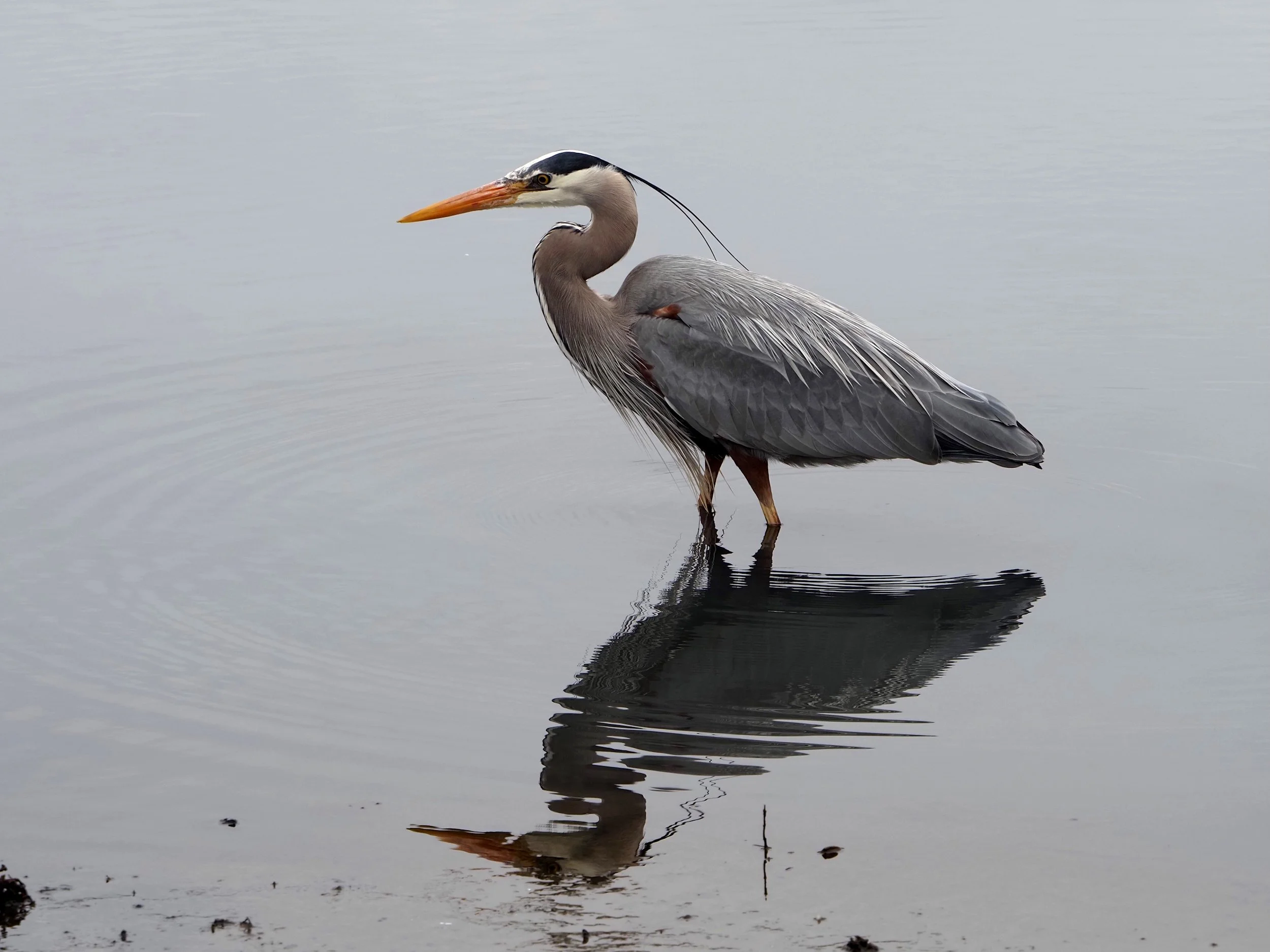
Great Blue Heron in Dungeness Bay—Photo: Bob Boekelheide
By Ida Domazlicky and Jane Nicholas
Most people—even children—can identify the tall, slate‑gray wading bird we call the Great Blue Heron, but few of us have ever been close to one—or wanted to be, perhaps. In flight, they have always reminded me of pterodactyls, or rather of my own mental image of what an intimidating pterodactyl might have looked like. Few birds can match great blues for size. They stand on long legs, and their body length alone, head to tail, can reach 50 inches. Add to that a 16‑inch, sword‑like bill backed by a strong S‑curved neck, and you have a bird that is nothing to mess with.
Great Blue Herons near John Wayne Marina—Photo: Bob Boekelheide
Nevertheless, on a cold November night some years ago, I found myself riding shotgun in an old blue pickup truck on a dark southern Illinois highway. Next to me on the bench seat sat a Great Blue Heron wrapped securely in old sheets, its wings and beak strapped snugly to its body and its eyes covered by a strip of cloth. In the dim glow of the truck’s instrument panel, the bird seemed calm, perhaps grateful for the warmth from the heater. I am shorter than most adults, and the heron held its head nearly level with my own. Although I tried not to touch the injured bird for fear of alarming it, I sometimes felt its shoulder brush mine as it breathed steadily in and out. There was no fight left in it—or so I hoped. I was the designated wrangler, should the bird decide to protest its situation, and I had been warned of the obvious: a stab from a great blue could put out an eye, or worse. But on that chilly night in Illinois, the three of us rode peacefully all the way to the rehabilitation center, where the heron eventually healed well enough to be released to a bird sanctuary.
The bird I sat next to had been injured by an automobile. But human activities are far from the great blues’ only worry. Despite their size and power, they are no match for large predators. A few reports describe black bears eliminating small great blue colonies by climbing to the nests and feeding on the nestlings. But their most common enemy is the Bald Eagle. Herons seem to have no effective defense against them. If a Bald Eagle approaches a heron colony, the adults may erupt into loud, guttural alarm calls, flee, or hang upside down beneath the nest and flap wildly. Others stand their ground and fight, lunging at the eagle as it parries with its own aggressive attacks. Descriptions of these battles high in the rookeries read like scenes from Mothra vs. Godzilla, but the outcome is never in doubt. The eagles win and feast on nestlings—likely one reason for the apparent decline in heron numbers in the PNW since DDT was phased out.
Bald Eagle threatening an immature Great Blue Heron at Big Beef Creek Marine Reserve, Washington—Photo: Nate Chappell/Audubon Photography Awards
Great Blue Herons are among the most widespread birds in the New World. They nest along the Alaskan coast south to Mexico and the Galapagos Islands, across the continent’s interior to Newfoundland, and down the Atlantic coast to the West Indies. The largest rookeries are near major bodies of water. Great blues often feed by standing motionless in the shallows, waiting for fish to come to them. However, they also fish from perches, wade into ocean surf, and even drop in flight onto schools of fish. And if necessary, a great blue can find frogs, crayfish, grasshoppers, or similar treats in a dry field. Even a small backyard fish pond—such as one in Carlsborg where a great blue once showed up—may do quite nicely for a change of diet, at least until the pond is empty of prey.
Great Blue Herons foraging in Dungeness Bay—Photo: Bob Boekelheide
A Great Blue Heron’s long, sharp bill is knife, fork, spoon, and potato masher all in one. Closed or slightly open mandibles can take a large fish by stabbing it repeatedly until it is subdued, then impaling it or using the bill as tongs to carry it to a drier spot where it’s less likely to escape. The bird then uses its bill to gently toss and reorient the fish until it is aligned properly and can slide easily down the long heron throat. Smaller fish, under about 10 centimeters, require a different technique. Sculpin, sticklebacks, perch, and bass have protective spines meant to keep them from being swallowed. And unlike pterodactyls, Great Blue Herons have no teeth. But masticating the meal with that powerful bill until the spines are scraped off seems to work just fine.
Great Blue Heron with sculpin—Photo: Dow Lambert
Great Blue Herons are majestic birds, especially in spring breeding plumage. Because they are so easy to identify, even birders don’t usually pay much attention to their plumage. But in 2020 at Dungeness Landing, one large wading bird stood out for its extensive white on the head and belly. I tried hard to classify it as a wandering Tricolored Heron. But tricoloreds are a bit smaller, and they feed by running madly through the water. Our tall and sedate whitish heron was, instead, a leucistic great blue—its body showing patches of reduced pigment, though the eyes remained normally colored. The bird returned the following summer, and Bob Boekelheide reports that it has been seen in Dungeness Bay every year since. His wife, Barb, even named it “Carte Blanche.” Unlike some birds with color aberrations, Carte Blanche seems to be thriving. Whether it has managed to acquire a mate is unknown, but it would be interesting to find out.
Leucistic Great Blue Heron, “Carte Blanche” at Dungeness Landing—Photo: Bob Boekelheide
So where might Carte Blanche go to nest? Some Great Blue Herons migrate considerable distances, but our PNW birds appear to disperse more locally. The nearest large colonies of great blues are near Padilla Bay in Skagit County and at Beacon Hill Park in Victoria, BC. The March Point forest rookery in Skagit has been occupied since the 1950s and is one of the largest in North America, but it is closed to public access to protect the birds. On the other hand, just across the Strait, Beacon Hill Park hosts an accessible great blue rookery. It was temporarily abandoned in 2007–08 due to severe eagle predation, but researcher Robert Butler reports that it was quite active in 2026. Because the park is easily reached from the city, it might be a good place to look for Carte Blanche next spring. Herons typically return there in January and February for mating, and nesting happens from March through June, when the young birds fledge.
Great Blue Herons in Marymoor Park, Redmond, WA—Photo: Mick Thompson
Newly fledged Great Blue Herons have about a 50% survival rate in their first year, but canny, lucky adults can live as long as 23 years in the wild. Carte Blanche has survived for at least seven years and is in Dungeness Bay as I write in late August, most often in the salt marsh and mudflats on the west side of the Dungeness River, between the river and Dungeness Landing Park. It is not alone. August and September are the best times to see Great Blue Herons in Dungeness Bay, and around 30 individuals gather in the Dungeness Landing/Three Crabs area most days. Binoculars are helpful for observing plumage and behavior, but not necessary to enjoy the sight of them stalking through calm waters, backed by Mt. Baker or the Canadian Coastal Mountains. And if any of these Great Blue Herons in flight put you in mind of pterodactyls, you’re only off by 66 million years—and an asteroid.