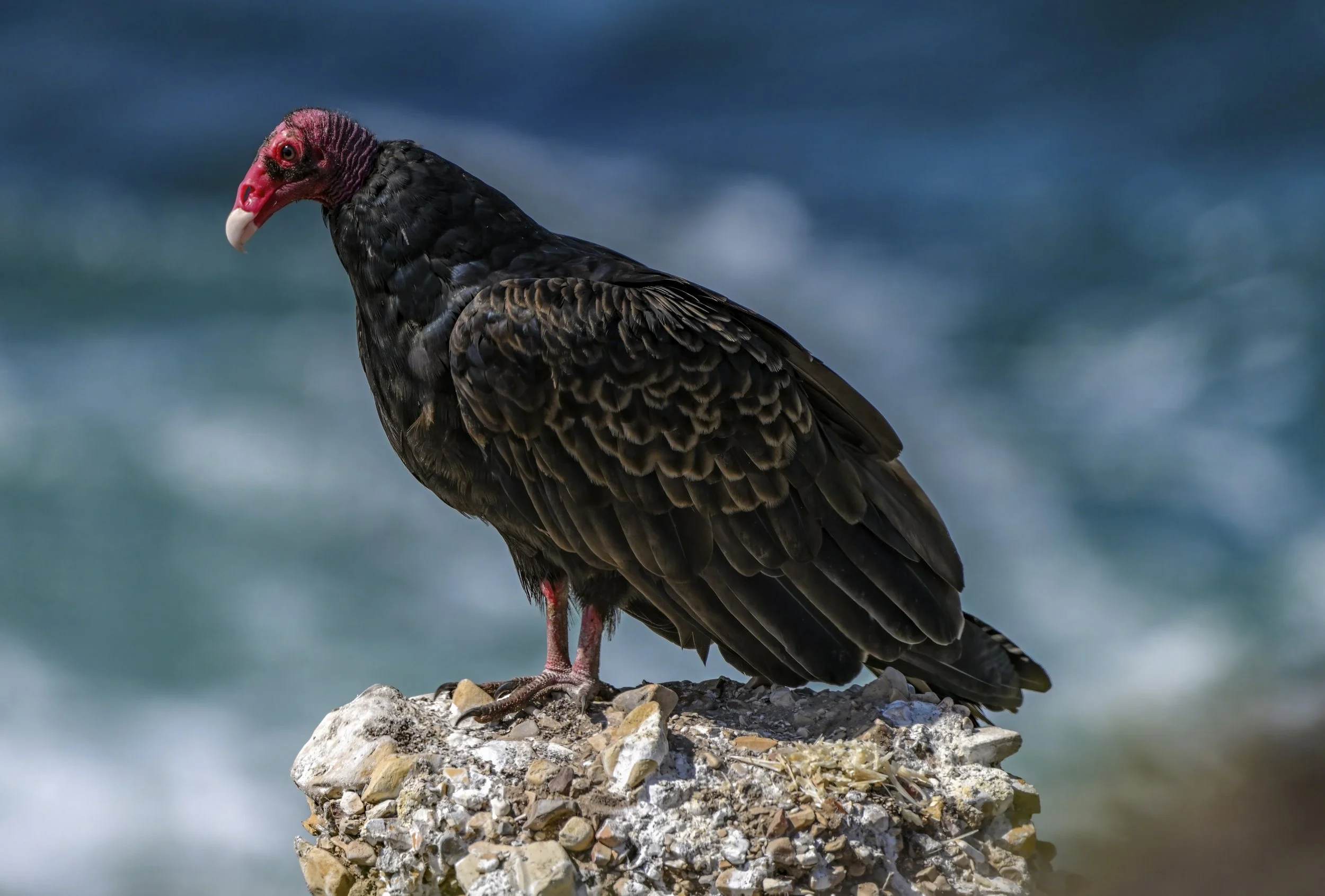
Turkey Vulture—Photo: Derek Rath/Audubon Photography Awards
Over to the Dark Side: Vultures
by
Ida Domazlicky and Jane Nicholas
November is probably nobody’s favorite month. Already, the increasing darkness and cold days foreshadow the long nights to come. Appropriately, our two autumn holidays remind us of the more precarious nature of survival in winter. Thanksgiving nudges us to remember that food and community are essential in this world.
Halloween is more direct. Even in its commercialized modern form, Halloween symbols take note of death at the time of year when we see endings all around us. Skeletons, zombies and ghosts abound. And in cultures around the world, the unambiguous avian symbol of death is the vulture, including our own Turkey Vulture.
The Turkey Vulture’s dark plumage, its naked red head, and its obligate preference for eating the flesh of dead animals have convinced many that vultures are disgusting and evil birds. “Disgusting” actually has some basis in fact. As a young teen, ornithologist George Miksch Sutton located a Turkey Vulture nest in a hollow log and wriggled in to investigate, only to find that he could not back out, but only slither forward. With his shirt halfway torn off, he inched towards the far end of the log, pushing ahead of him frantic field mice and daddy long legs. And when he reached the egg and downy white vulture chick, the protective mother bird vomited up her last meal. So yes, a defense strategy that involves projectile vomiting of rotten meat is disgusting.
But are vultures evil? Aggressive? Dangerous? During our spring Pacific Northwest Turkey Vulture migrations, with a couple dozen circling overhead, more than one nervous person has asked me whether vultures will attack people or kill pets. Young G.M. Sutton found the opposite to be true. “Pushing the baby, egg, and wad of decayed flesh ahead of me, I reached the rocks [and crawled out]. When I grasped the old bird by its feet, I was surprised by its refusal to bite. It hardly even flapped its wings.” He easily tied up the vulture until he could clean himself up a bit, then returned egg, chick and mother bird to the log, along with a dead mouse as an apology. So if, in a worst-case scenario, you happen to find a Turkey Vulture checking you out as you lie semi-comatose on the ground, just wave at it. It will shyly retreat a little distance to await your actual demise.
Turkey Vulture—Photo: Dow Lambert
Worldwide, vultures are the janitors that clean up the dead on our roads and fields. Nothing has emphasized this housekeeping value of vultures more dramatically than in India, where its three vulture species’ populations were all reduced by over 95% in the 1990s after cattle were treated with the pain-killer diclofenac. Vultures acquired diclofenac in minute quantities by consuming dead cows, and it killed them. In the ensuing years virtually without vultures, the country has seen an estimated 500,000 extra human deaths and around $34 billion in economic losses directly linked to their near-absence. A ban on veterinary use of the drug has allowed vulture populations to begin recovering.
Aside from our appreciation of them as a clean-up crew, Turkey Vultures are fascinating birds. Eggs require about a month of incubation, followed by another two months of care before the young birds can fly. When a Turkey Vulture hatches, it is covered in pale downy feathers, including on its head. As it grows into a juvenile, the head becomes largely bare and dark gray to black. This is a key difference from adults, whose bald heads are vivid red. At that point, the juvenile vultures are feathered in deep black, standing 2-3 feet tall with an impressive 6-foot wingspan. Like the adults, their heads are largely bare of feathers, presumably to facilitate easier washing after dipping into carcasses. Their stomachs are extremely acidic, allowing them to digest just about anything found in nature without becoming ill, including all the toxic messes that make other creatures avoid rotten food: anthrax, tuberculosis, rabies, etc.
Turkey Vulture chicks—Photo: Jan Nickols/Audubon Photography Awards
Amazingly, Turkey Vultures can find carcasses by smell even if it is hidden below tree canopies. Though carrion is their favorite, they will eat anything from grasshoppers and snakes on up, even algae or pumpkins if other food is hard to come by. While they often search alone, vultures are not anti-social. They roost near one another at night, preening their feathers and observing each newcomer as it arrives. Like some of us, they are late risers, perhaps to allow time for aromas to become easier to detect as the day warms. When carrion is found, they often share it not only with other vultures but also with scavengers such as coyotes. They are a largely silent species, but if upset or threatened they may hiss or emit a low growl.
Turkey vultures were once scarce in the Pacific Northwest, but over the past few decades, the number here during the warmer months has grown. We know that they head for our southwestern states by about October and begin returning in the spring, but little is known of their behavior while they are here. Our coastlines, beaches, islands, and evergreen forests are quite different from the southern landscapes they are traditionally familiar with. The University of Victoria and Pacific Northwest Raptor scientists have teamed up to find out how they nest, breed, and survive in this new environment by tagging 13 Turkey Vultures with solar GPS units since 2022. Preliminary results indicate that our local birds have smaller territories than elsewhere in the species’ range and are more social in their nesting, perhaps reflecting increased family or group cooperation. Cameras set up at some of the nest sites will try to provide details and explanations of these behaviors as the study continues.
My own most memorable experience with Pacific Northwest Turkey Vultures emphasized the social nature of these birds, but that was far from my first, gut-level response. In June of 2026, I was doing citizen science for Cornell University’s Climate Watch study, which involves visiting chosen sites twice a year and recording all birds seen and heard in five minutes. I had only one spot left to survey that morning, a location above Sequim with a great view of mountains, second-growth forests, and the strait. As my car pulled into the site with all windows down, a huge cloud of black wings exploded from the ground and up over the car, blotting out the sun for several seconds. At that moment, I was in fight-or-flight mode. My reptilian brain screamed that I was about to be attacked and possibly overwhelmed by what turned out to be 19 Turkey Vultures who were, in fact, only trying to rid the scene of a dead something. I didn’t check what.
Once my heart rate returned to normal, I started my timer and included the vultures in my usual Cornell report. Patient with the interruption, the frightening-looking birds sat just across the road from me. Singly and in twos and threes along bare branches, they watched calmly, the big eyes in all their red heads showing both curiosity and a willingness to wait. A few minutes later, safely at home, I told the story and laughed about the fright they had given me.
The decorations and events of this recent Halloween reminded me of that day. Once again, we vulnerable humans, who so much love life, did what we have done for thousands of years. We looked at death, and we acknowledged its inevitability. We created symbols to reflect its reality and our fears. And then we had fun with it. I think that the vultures, if they could understand that, would approve.