
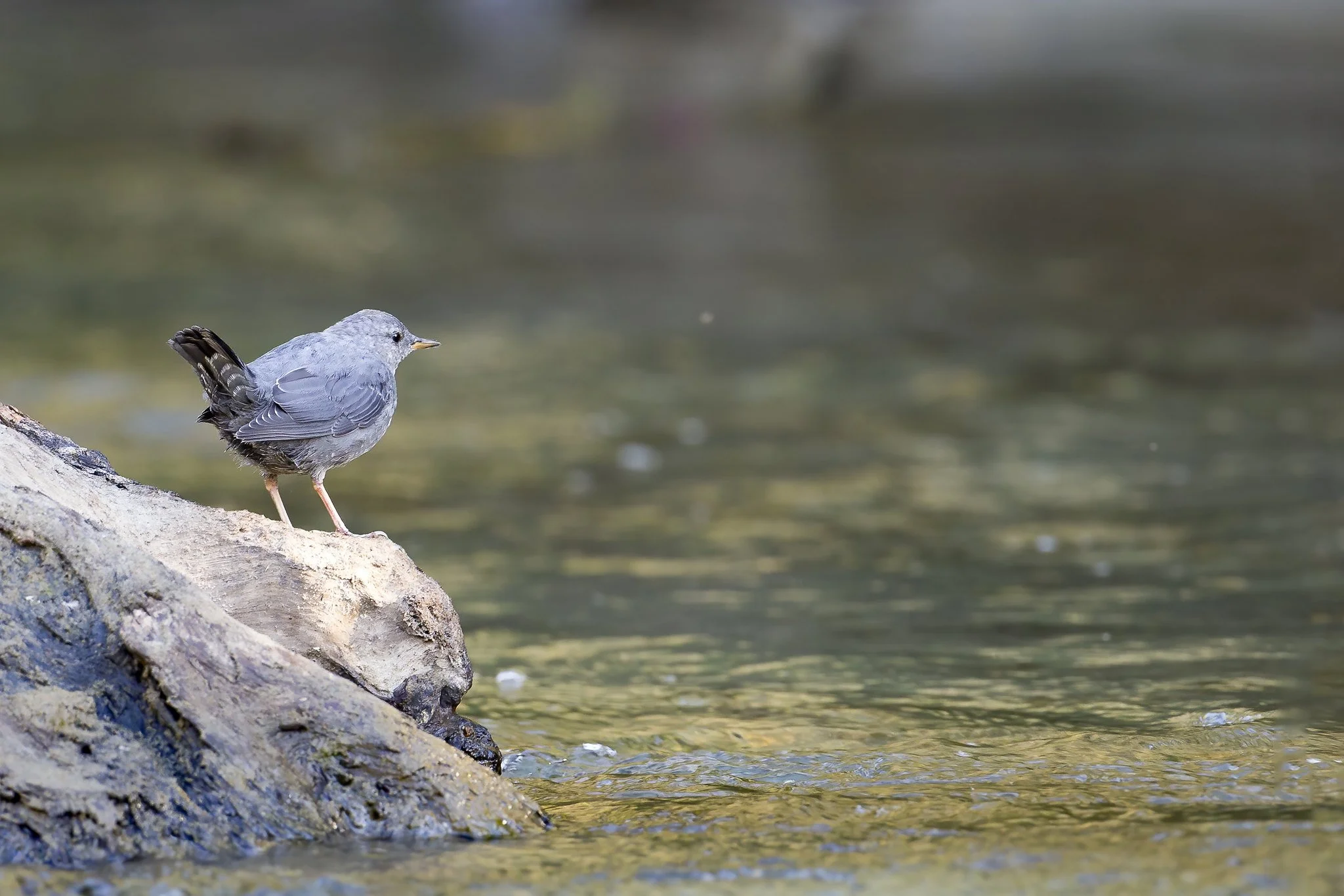
American Dipper — Photo: Mick Thompson
Our Own Water Ouzel: The American Dipper
By Ida Domazlicky and Jane Nicholas
On one of my first trips to the American West, I was walking along the banks of the Thompson River near Estes Park, Colorado, when I noticed a large mossy nest tucked under a bridge. The birds were busy bringing food, then flying off downstream again. Suddenly, three fat, fuzzy nestlings tumbled out of the nest and dropped straight into the rushing water below. I panicked. In the Midwest, only swallows nest under bridges—and swallow fledglings drown easily. I was sure I was about to witness an avian domestic tragedy.
But to my surprise, these three babies bobbed along in the fast‑moving stream like fat corks. Two floated downriver and out of sight, but one scrambled onto a rock just a few feet from me. Each time a parent bird flew past, it opened its beak wide, clearly screeching “feed me!” Once again, I thought the fledgling was doomed. How could its parents keep up with youngsters scattered so far along the river? But these were American Dippers, the only truly aquatic North American songbird. The parents zipped back and forth along the mountain stream, stopping every third or fourth trip to stuff something into that noisy little beak. For dippers, this was normal life. For me, it was love at first sight.
American Dipper fledglings — Photo: Dow Lambert
North American Dippers may not look like anything very special at first glance. When they cock their tails, they can look a bit like gray, short‑tailed wrens. But no other North American songbird can float, walk underwater, or stand submerged in and under mountain rapids. In a promising section of river, the little bird may plunge in and use its wings to “fly” underwater for as far as 20 feet, then burst back into the air and whizz off over the stream as if it were dry land. In midstream, it might walk through the turbulent rapids or paddle along the surface to gobble up floating larvae. While under the water, it casually walks and turns over rocks to hunt for food as if there were no current trying to wash it away.
American Dipper — Photo: Richard Spratley/Audubon Photography Awards
So how do dippers do all this? Ornithologists have a few explanations. Dippers’ legs are a little longer than would be expected of a bird their size, but both legs and feet are of standard songbird construction. They have a low metabolic rate, and their blood has extra capacity to carry oxygen, allowing them to remain underwater for up to 30 seconds in frigid temperatures. Preening is important for all birds but is critical for dippers. They have a soft outer coat of feathers over a thick undercoat of down, which of course would soon be sodden if they were merely typical songbirds. But dippers have a preen gland 10 times the size of their wren cousins. And like kids wearing nose clips at the swimming pool, they use a special flap over their nostrils to keep water out as necessary.
Another unusual thing about dippers is that their eyes sometimes flash completely white. It’s easy to notice because they blink more slowly than most birds. The white isn’t the translucent third eyelid called the nictitating membrane that all birds have, which functions like built‑in, optional goggles. In addition to that membrane, dippers have an upper eyelid covered in tiny white feathers. Is this slow, obvious blinking somehow tied to their watery lifestyle, or perhaps a way to signal to other dippers over the noise of rushing streams? We don’t know.
American Dipper — Photo: Bob Boekelheide
Dippers are fairly common in mountain streams from the Aleutian Islands to the Mexican highlands. The charming old European name for the species is Water Ouzel, a term still sometimes used for any of the dippers. Our own ouzel gets the name dipper from its habit of bobbing its whole body 40–60 times per minute, perhaps as a form of camouflage. Two other water‑loving songbirds, the waterthrushes, also bob habitually, which may help them blend into the motion of running water.
To find a dipper, listen year-round near our Pacific Northwest rivers for their very high, crystal-clear, warbling song, which is loud enough to be heard over the roar of Sol Duc Falls.
Dippers seem perfectly content to build their nests on a cliff or even on a rock in midstream. Hal Harrison, an expert on nests, once wrote that he “watched [dippers] building behind a swift‑moving cascade in the Colorado mountains. Birds approached water on a slanting log, nest material in bill, then dove into the falls. Nest completely hidden from sight.” Dippers also take advantage of bridges that span their streams. Some years, there’s a dipper nest on the lower rail of the Railroad Bridge in Sequim. In May or June fledglings from that nest may settle into the quiet pools below the east end of the bridge to wait for their meal deliveries — a far calmer entry into the world than the youngsters I saw in Colorado. The tamest dipper I’ve ever found preened and rested while my grandkids played just a few feet away in Barnes Creek, below the bridge near the Crescent Lake cabins.
American Dipper with nest materials — Photo: Teri Franzen/Audubon Photography Awards
It’s been years since I watched that first tiny dipper bobbing along the Thompson River, but I continue to regard dippers as possessing unexplained superpowers. None of their known physical adaptations fully explains how a six‑inch, two‑ounce ball of fluff can fly through waterfalls, swim with unwebbed feet, or casually pick at larvae while submerged in a current that might knock me off my feet. And for me, dippers remain the one creature that best personifies the magic of our mountains. As John Muir wrote in 1894, “…not one [stream] was found without its Ouzel…He is the mountain streams’ own darling, the hummingbird of blooming waters, loving rocky‑ripple slopes and sheets of foam as a bee loves flowers, as a lark loves sunshine and meadows.”