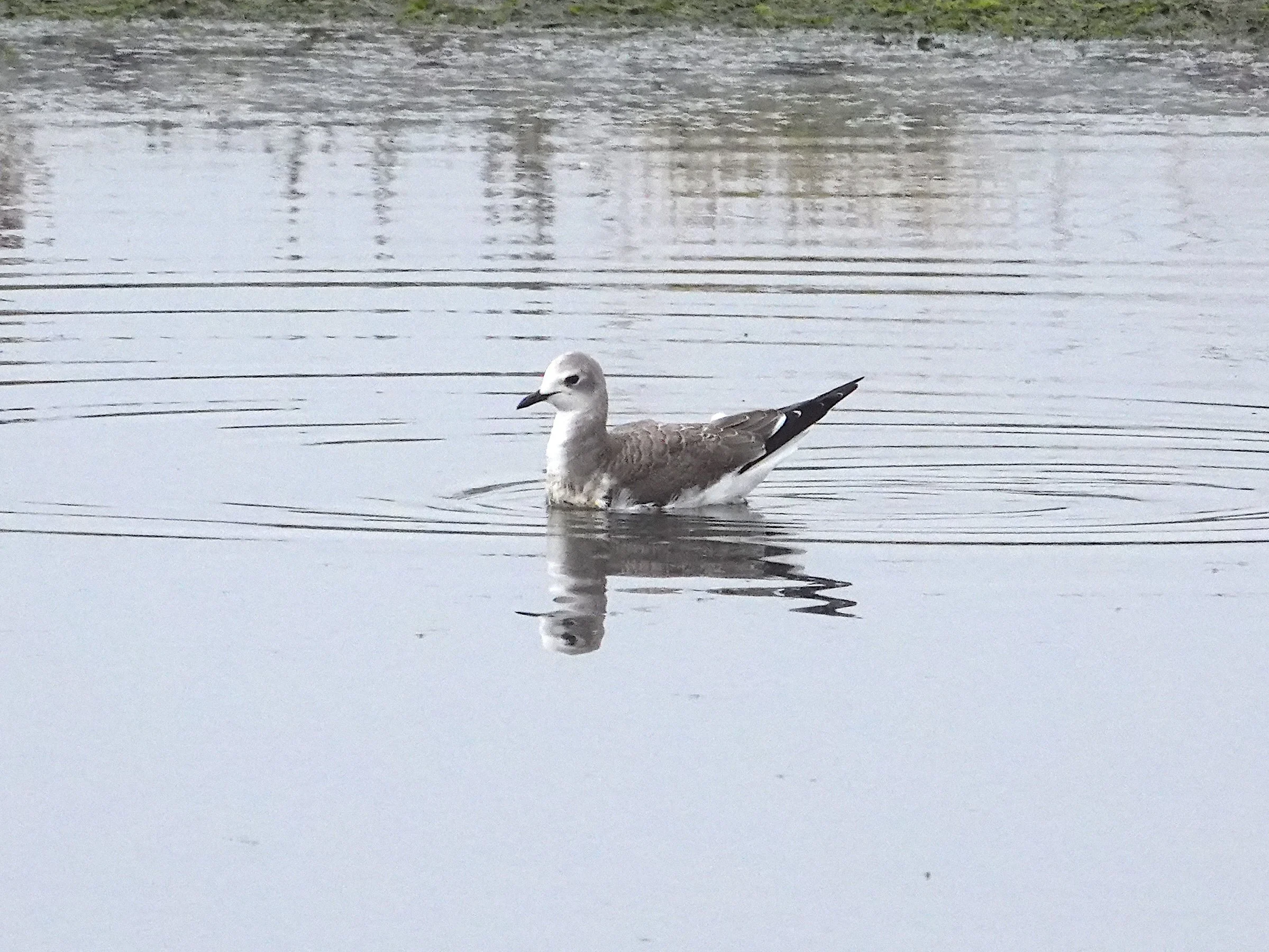
Juvenile Sabine’s Gull—Photo: Bob Boekelheide
Juvenile Sabine’s Gull Spotted at Three Crabs
by Bob Boekelheide
November 3, 2026

Bud Taliaferro found this lovely juvenile Sabine’s Gull at Three Crabs on November 1, 2026. It is still here as of November 3rd, hanging around the mouth of Meadowbrook Creek and the nearby pond where the old Three Crabs Restaurant used to be.
Sabine’s Gulls are long-distance migrants, nesting in the high Arctic around the globe and wintering at sea off the west coasts of South America and Africa. They are a true pelagic species, usually staying offshore and infrequently seen from land. The most abundant flocks of Sabine’s Gulls in Clallam County are usually seen at Swiftsure Bank several miles west of Cape Flattery, where sometimes several thousand Sabine’s Gulls can be seen on pelagic boat trips during spring and fall migration.
Juvenile Sabine’s Gull. Note possible damaged flight feathers. Photo: Bob Boekelheide
Sabine’s Gulls were named by naturalist Joseph Sabine in honor of his brother Sir Edward Sabine. Edward Sabine was one of the noted physicists of the early 19th century, specializing in the Earth’s magnetic fields and studying how to accurately determine latitude using magnetism. The Sabine family pronounced their name to rhyme with “cabin,” emphasizing the first syllable, so Sabine’s rhymes with “cabins.”
The little Sabine’s Gull at Three Crabs appears to have some damaged flight feathers, with some odd gaps around its first few primaries on both wings. Juvenile Sabine’s Gulls usually do not molt their flight feathers until much later in the winter and spring in the Southern Hemisphere, so it is a bit of a mystery. For the time being, it is contentedly pecking small prey items from the water’s surface at Three Crabs. We’ll see how long it sticks around.
Juvenile Sabine’s Gull pecking small prey items—Photo: Bob Boekelheide