
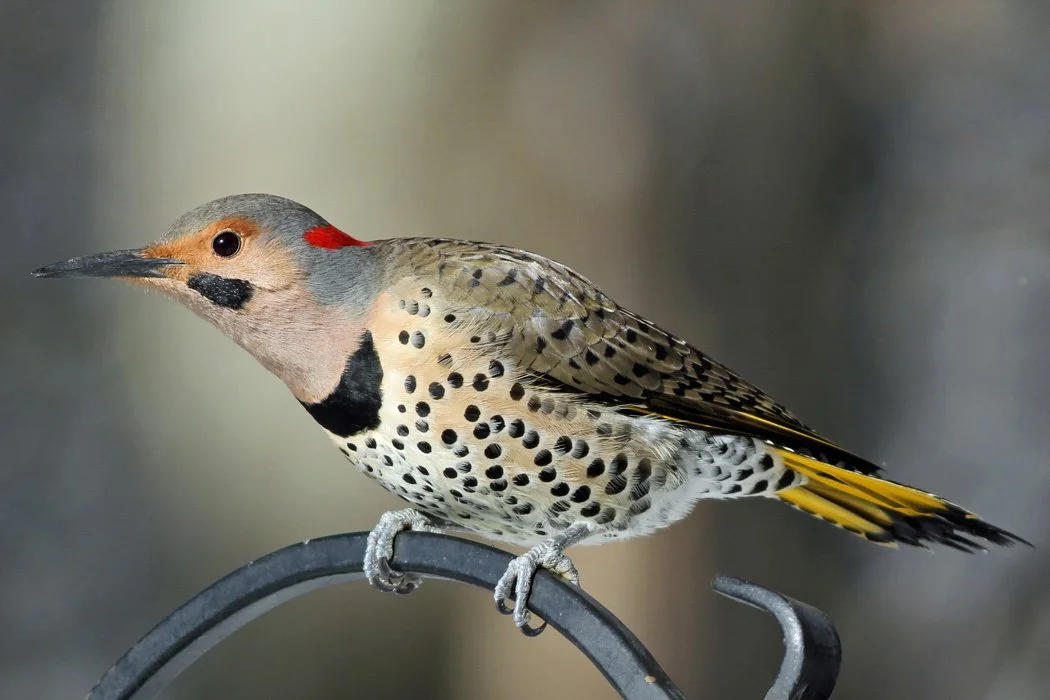
Yellow-shafted Northern Flicker—Photo: Barbara Tomawski/Audubon Photography Awards
Narrative by Bob Boekelheide
Look closely at those flashy Northern Flickers here in winter. You probably know the "Red-shafted"-type Flickers, the usual flicker morph found in the Pacifc Northwest. A typical male "Red-shafted Flicker” has a red mustache on a bluish-gray face, a brown cap, little or no red markings on its nape, and salmon-red shafts and feathers on its wings and tail. The females lack the red mustache.
Northern Flicker—Photo: Dawn Key/Audubon Photography Awards
In winter, a surprisingly large proportion of flickers on the north Olympic Peninsula are “intergrades,” or genetic crosses between Red-shafted and Yellow-shafted Flickers. Occasionally we even see "Yellow-shafted" types around here, like one being seen in West Dungeness this winter.
Yellow-shafted Flicker at a Dungeness Feeder—Photo by Barb Boekelheide
A typical male “Yellow-shafted Flicker” has a black mustache on a brown face, a gray cap, a big red nape mark, and bright yellow shafts and feathers on its wings and tail. Yellow-shafted types are usually found east of the Rocky Mountains.
Yellow-shafted Flickers are usually observed east of the Rockies. Photo: Jennifer Miner/Audubon Photography Awards
Before 1982, Red-shafted and Yellow-shafted Flickers were separate species. In 1982, the American Ornithologist Union lumped the two morphs into one species called “Northern Flicker,” because the two types freely hybridized and the hybrids are fertile. The intergrades can be any combination of either Red-shafted or Yellow-shafted characters, along with typically orange shafts and feathers in the wings and tail. It’s thought that many of the intergrades found here in winter come from an area where Red-shafted and Yellow-shafted types overlap in northern British Columbia and Alberta.
For more flicker info, check out the OPAS website at https://olympicpeninsulaaudubon.org/dungeness-data/those-flashy-flickers