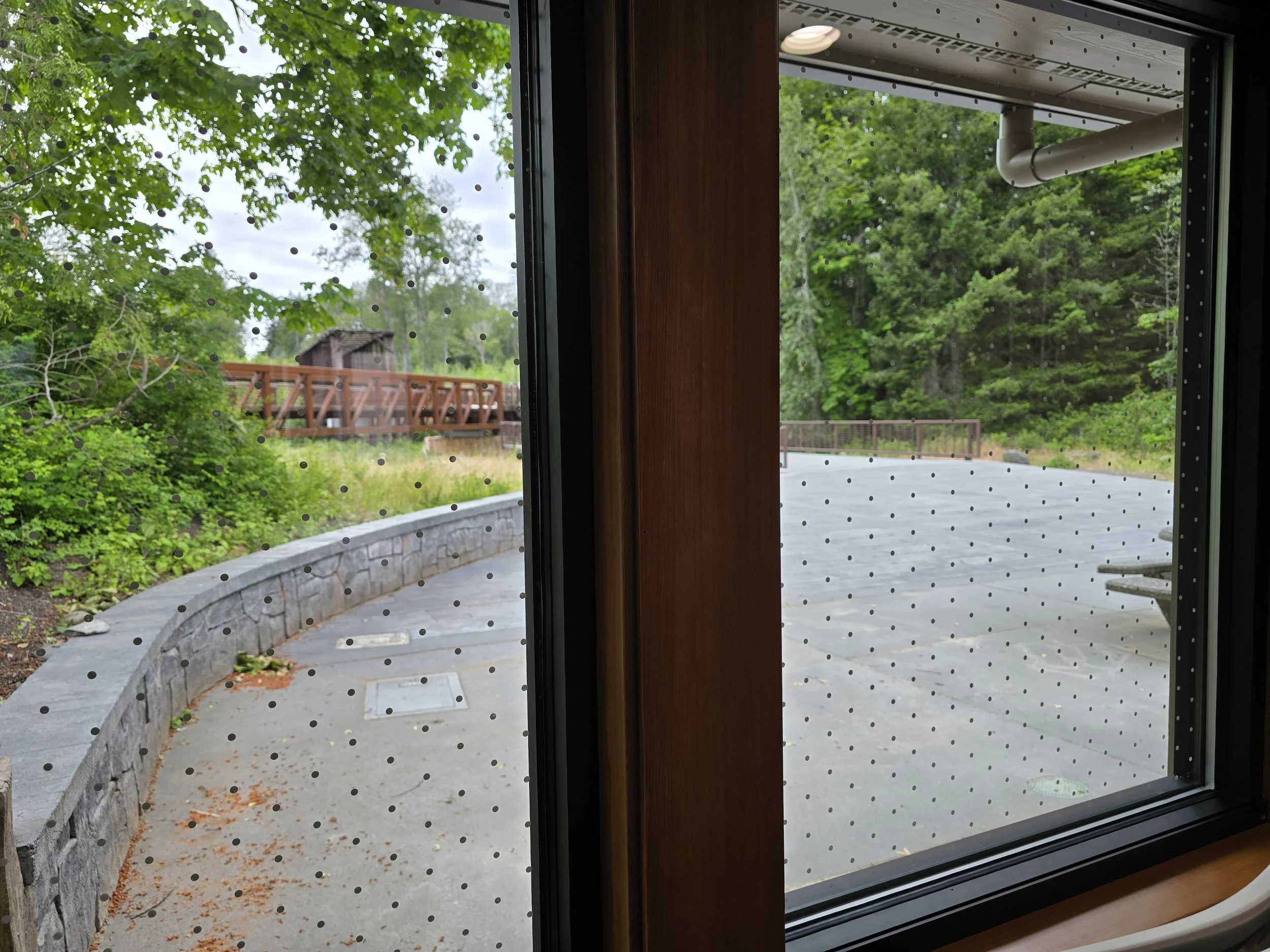
Feather Friendly dots retrofit on commercial windows stop bird collisions—Photo:Dee Renee Ericks
Bird Collisions With Glass
SOLUTIONS For Your BUSINESS
Birds do not perceive glass like humans do. They do not recognize glass as a solid object. Glass is a problem because it is confusing for birds as an invisible obstacle and as a reflective surface.
Collisions occur when birds fly towards natural reflections in window glass, where they see clouds, sky, or vegetation.
Spotted Towhee, victim of window collision—Photo:Dee Renee Ericks
Glass is an indiscriminate killer, culling the healthiest members of a population as well as the weakest. Many of the victims are songbirds whose populations are already in decline.
Retrofitting Windows
in an existing building is becoming easier with today’s products.
Biotech Joey Gish applies Feather Friendly dots to reflective windows on the science building at Peninsula College—Photo:Dee Renee Ericks
Bird-building collisions can happen at any time of the day and year, but tend to increase during migration and when young birds start flying. Therefore, the most crucial times for these measures are during spring and fall migration and in the breeding season.
Acopian BirdSavers added to reflective windows to break up reflection—Photo:Dee Renee Ericks
Products Available for Retrofit:

Mirrored structures
Placed in a natural setting, mirrored structures have become a popular international architectural trend, especially for vacation short‑term rentals. These may be marketed as:
mirrored “invisible” cabins,
reflective tiny homes,
glass “forest pods”, or
mirror‑clad saunas and spas.
While visually striking, these structures pose a significant and often unrecognized threat to birds. Their reflective surfaces mirror surrounding habitat — forest canopy, sky, and vegetation — creating the illusion of open flight paths. Birds interpret these reflections as real habitat and collide with the surfaces at high speed.
Any mirrored structure positioned in a natural surrounding is a hazard to birds—Photo: Peter Schulz on Unsplash
Mirrors create perfect, high‑contrast reflections of forest canopy and sky.
Birds interpret these as actual habitat, not glass.
Unlike windows, mirrors often cover entire walls.
Cabins are placed in prime habitat — forest edges, riparian zones, meadows.
Many are marketed as “invisible,” which is exactly the problem.
This is a collision‑risk profile far worse than typical residential glass.
Mirrored structures in natural areas pose extreme collision risks. There are no known solutions that would alleviate avian injury or death.
Commercial Glass is Particularly Hazardous for Birds
The architectural features that make modern commercial buildings attractive for businesses make them deadly for birds. Floor-to-ceiling windows, use of reflective glass, and glass walkways create the perfect conditions for bird strikes.
In commercial buildings, the extensive use of mirrored or tinted glass which make vivid reflections of sky and vegetation, causes birds to interpret those as safe flight corridors. Glass walkways between buildings create “tunnel effects” where birds attempt to fly through what appears to them to be open space.
Vivid reflections of commercial glass windows cause life threatening hazard to birds—Photo: Dee Renee Ericks
Landscaped courtyards surrounded by glass walls become attractive habitat areas that birds can enter but struggle to escape safely. The prevalence of night lighting in commercial buildings also disrupts nocturnal migrants, drawing them into dangerous collision zones.
Reflective windows off a heavily vegetated courtyard put birds in danger while searching for a way out—Photo: Dee Renee Ericks
A “Bird Friendly Building Design” pamphlet by The American Bird Conservancy, assists developers, architects, building owners, regulators and anyone else looking for detailed information on the collisions issue and designing structures to minimize bird deaths. You can download a free pdf.
There are no known solutions for bird safety in the use of highly mirrored, manufactured materials. Take a look at bird-safe design standards.
Designers and architects who are aware of bird-window collision hazards, can use creative techniques and materials to reduce or eliminate collisions. These choices are best incorporated into the original design of a building. Check out the latest Bird Safe design solutions now available at Bird Collision Prevention Alliance. There are Patterned Bird Safe Glass types, (Acid-Etched, Ceramic Frit, Lasered Patterns, Laminated Embedded Materials, and Reflective Coatings) and Non-Float Glass Deterrents (Textured Glass, Channel Glass, and Glass Block).
Bird-friendly window glass was installed in the Dungeness River Nature Center. The ultraviolet striping is visible by humans only in some light conditions . Birds see in ultraviolet spectrum—Photo: Dee Renee Ericks
Smart landscaping around commercial buildings can significantly reduce bird strikes. Removing or relocating vegetation that reflect in nearby glass and carefully planting trees and bushes so that they don’t channel birds toward glass surfaces, can help create a safer area for both resident and migrant bird populations.
Commercial property managers are increasingly implementing bird-strike reduction programs centered around “Lights Out” initiatives. These are coordinated efforts to reduce artificial lighting during peak migration periods (March 1-June 15th and August 15-November 30th). These programs represent one of the most effective strategies for protecting migrating birds plus offer savings in the cost of electricity.
Audubon encourages every community to take actions that benefit both birds and people.
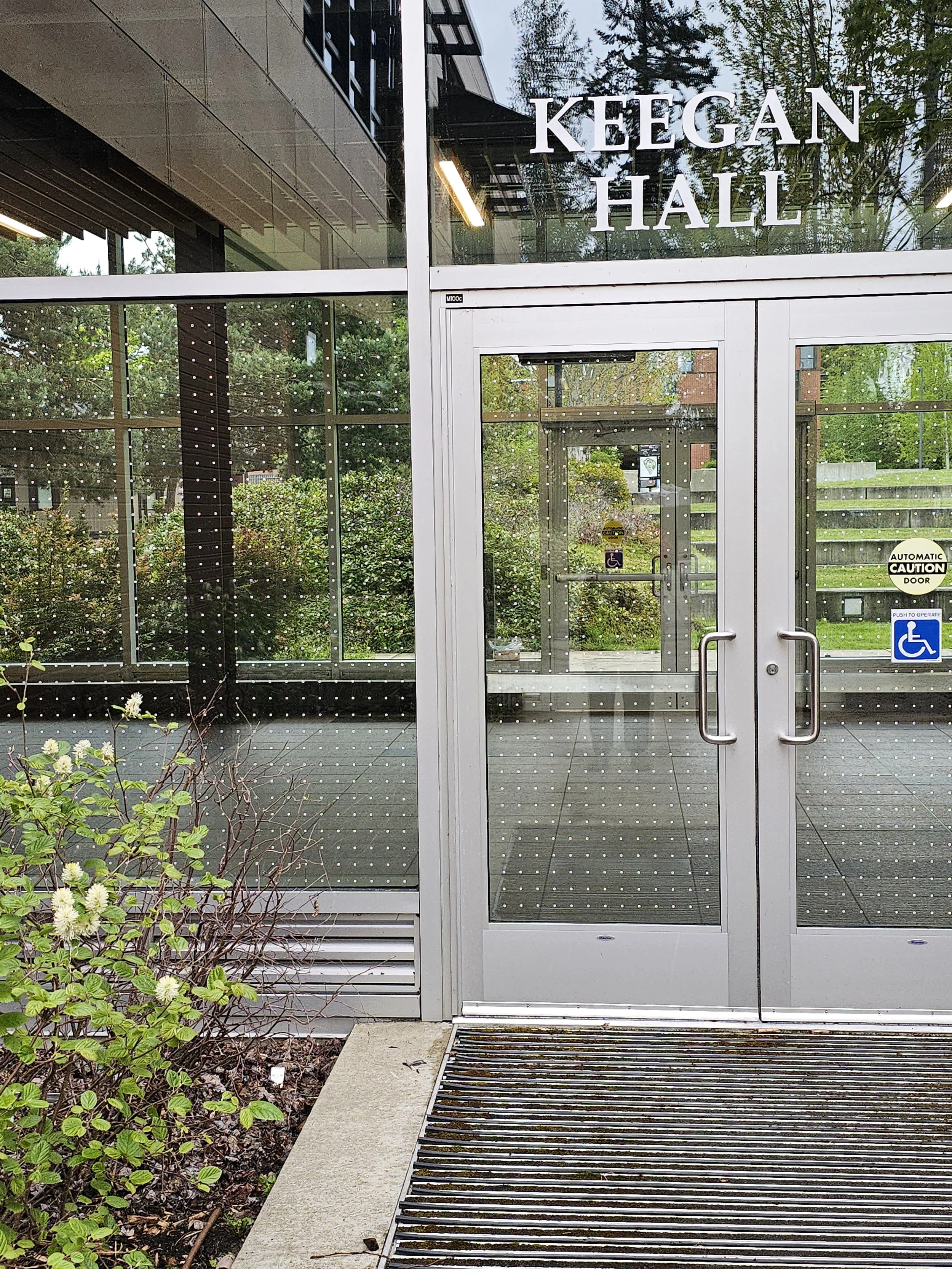
Peninsula College, aided by National Audubon Society grant money, is adding Feather Friendly markers to windows that are hazardous to birds—Photo: Dee Renee Ericks

Window strike victim—Photo: Dee Renee Ericks