
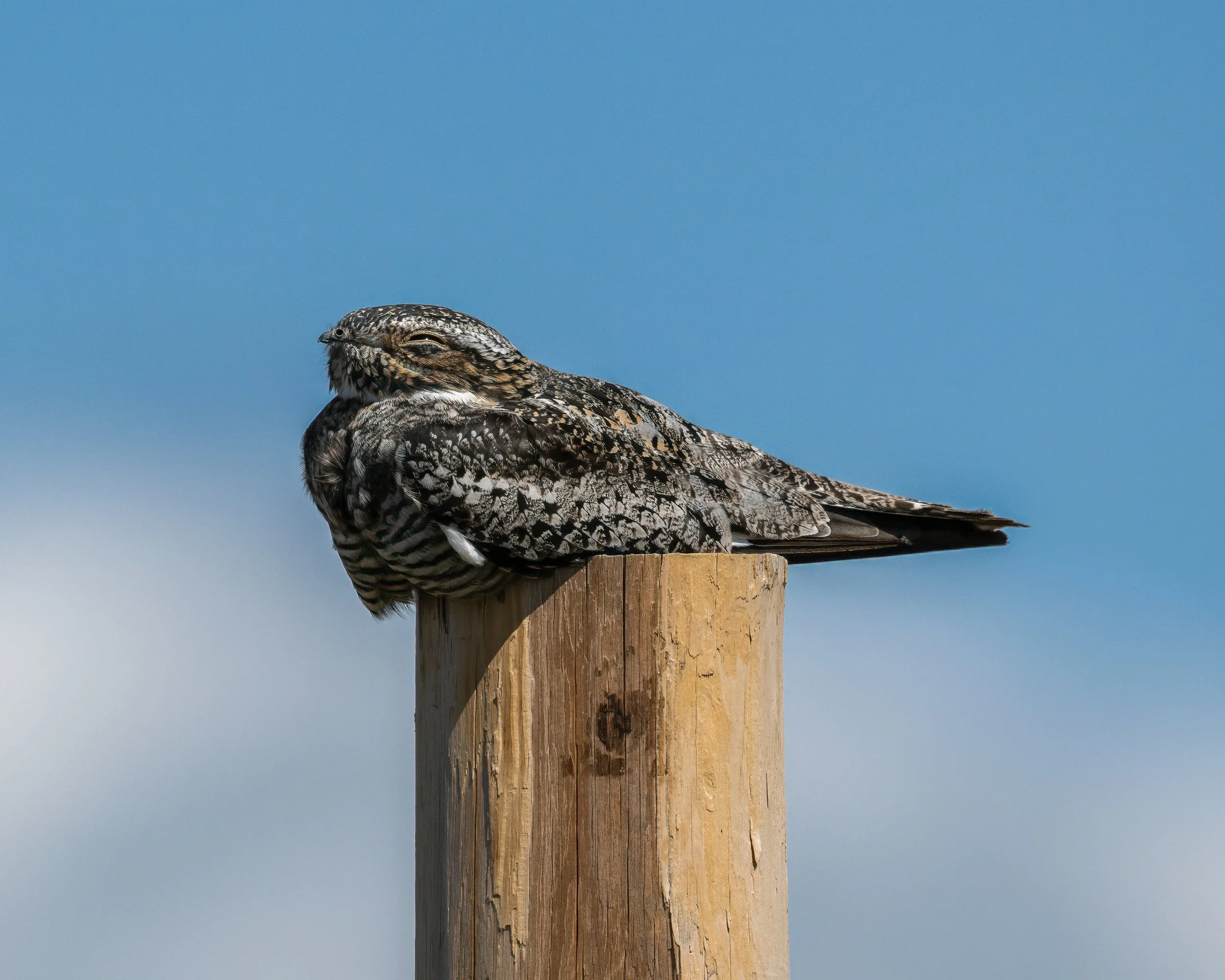
Common Nighthawk—Jennifer Blankenship/Audubon Photography Awards
Nightflyer: The Curious Life of a Nighthawk
by Ida Domazlicky and Jane Nicholas
The voice on the phone sounded perplexed. “You’re the bird lady, right? Well, I don’t know what kind of bird this is, but I think it must be hurt, because it’s just sitting there flat on the ground, not standing up at all.”
In answer to my questions, the caller added that the bird was about the size of a robin but “chubby, kind of stripey gray and brown with a really tiny bill, like a goldfinch.” Hmmm. Not a terribly helpful description. I had been a birdwatcher only long enough to write a weekly column for the local newspaper as I learned by researching. Still, I decided to check this bird out, if only to get it to the local rehab center.
The bird in question sat beneath a small tree in a parking lot island at the local university. And it was indeed an odd sight. Its bill was barely big enough to notice among its mottled plumage, and it sat solidly in the soft green grass as if incubating eggs. As I inched closer, the narrow horizontal slits at each side of its head shot open to reveal large, luminous, rectangular black eyes that watched my every move.
Common Nighthawk—Photo: Connor Charchuk/Audubon Photography Awards
But the biggest surprise came when I took two more steps forward. Suddenly, the tiny beak shot open and became a cavernous, hissing mouth. I immediately took two steps back. What was this thing?
The identification came after a few minutes of flipping through my paperback Peterson field guide. While I had heard and seen numerous nighthawks overhead, I had never been close to one. The bird before me on the grass was, of course, not injured at all. It was simply resting on the ground, as nighthawks do when they’re not stretched horizontally along a tree branch or hunkered down on the gravel roof of a flat‑topped building.
The bird I knew as a nighthawk was a slender‑winged marvel of grace in flight, a shadowy presence overhead each evening just as the light gave way to the first stars. Hearing its incongruous frog‑like croaks as it hunted insects had always made me smile. But I had never imagined that, close up, this elegant, long‑winged flyer would look so strange.
Common Nighthawk hunting insects—Photo: Mark Hainen Audubon Photography Awards
Common Nighthawks, which show up in the PNW in late May or June, are seriously misnamed. First, they aren’t related to any hawks, and they lack both talons and sharp bills. While they are most often active at dusk and dawn, they do hunt during the day. And their official family name—Nightjars, Caprimulgidae (“goat‑milker”)—is another misnomer, based on the old belief that nighthawks and their cousins swoop in at night to suckle milk from the udders of goats with those amazingly wide mouths.
Their species name, Chordeiles minor, is halfway correct, in that Chordeiles means something like “evening music‑maker.” But minor is just plain wrong, because the Lesser Nighthawk is actually smaller than the Common Nighthawk that we see here. Oh well. A rose by any other name, etc.
Names aside, our “nighthawk” is a fascinating bird. In courtship, performed high over houses or open spaces, the male shows off his white wing and tail bands in fluttering flight, then dives to produce a booming sound with his primary feathers—much as our male Anna’s Hummingbirds do when they produce their loud squeak. Once the pair bond is established, the female nighthawk chooses a rocky bit of ground or a flat rooftop, with openings in clearcuts being a local favorite. She lays her eggs directly on the ground without bothering to build any sort of nest—nighthawk feet are tiny and flat, unsuited to gathering nesting materials.
Lesser Nighthawk—Photo: Peggy Coleman/Audubon Photography Awards
Her mate feeds her for about 20 days as she incubates the eggs, and he helps feed the hatchlings. If she decides the heat is too much, the parents pick up each chick in those oversized mouths and carry it to a shadier spot. If a predator approaches too near the nest, the parent lures it away with a “broken‑wing act,” much as killdeer do. Once the young fledge, they join the adults and begin feeding themselves like speedy little vacuum cleaners in the air, soaring and twisting with mouths wide open at about 15 m.p.h. They begin communicating with a clicking sound—the juvenile version of the adults’ “peent” call that typically alerts us humans to their presence.
The insects that nighthawks gobble up go straight down their throats intact and can live for a couple of days before succumbing to gastric juices and the grinding action of their gizzards, which pulverizes any remaining hard‑shelled carapaces. Nighthawks are not picky about their food. They are known to consume at least 50 kinds of insects, including beetles, horseflies, plant lice, grasshoppers, and—best of all—mosquitoes. One nighthawk stomach was found to contain over 500 of the little bloodsuckers. Another nighthawk stomach, in Maine, reportedly held 2,175 winged ants, leaving us to wonder which grad student had the honor of counting.
Unfortunately, the final irony of this bird’s name, Common Nighthawk, is that as insect populations plunge due to pesticides and habitat loss, nighthawks are becoming less and less common. In the last 50 years, they’ve lost 60 percent of their population. Still, in July we can hear their croaking calls and booming dives at sunset and spot them winging gracefully over clearcuts and forest openings. Look for nighthawks at Dungeness Trails, high up Palo Alto and Fish Hatchery roads, on Miller Peninsula, and around the floodlights at night baseball games.
Common Nighthawk—Paul Lisker/Audubon Photography Awards
We like to think of nighthawks as “our” birds, but of course they belong to both Americas. In fact, they seem a bit reluctant to leave South America, as they are among the last migrants to arrive here in spring. Come August, the parents and young birds will gather in large flocks and head through Mexico and Central America to their winter (from our point of view) homes in South America—a journey of about 6,000 miles.
If you are very lucky this fall, you may find yourself amid dozens or even hundreds of migrating nighthawks calling and weaving just overhead at twilight, a magical experience. In the meantime, if you encounter a chubby brown bird sitting horizontal on a branch or stubbornly ensconced on the ground and hissing at you like an angry cat, don’t call the bird‑rehab folks. Just count yourself fortunate to have seen, up close, one of the PNW’s oddest birds.