|
$$PLAIN_TEXT_PREVIEW$$
|
Our Mission The Olympic Peninsula Audubon Society promotes birding and habitat conservation through science-based education, advocacy, and stewardship. __________________
|
January Harlequin Happenings Newsletter
|
|
Happy New Year! January brings a promising start to the new year for OPAS. Don’t miss our new Jan. 3 Backyard Birding presentation, Backyard Bird Population Trends, followed by a special Jan. 21 program on the Birds of Borneo—from the Malaysian side. This issue includes the Sequim‑Dungeness CBC results, a volunteer opportunity for the Winter Climate Watch, and two engaging articles—Watch Out for Merlins! and Helping Our Wintering Birds. Watch the replay of our Dec 6. Backyard Birds in Winter Video. We’re also giving you a sneak peek at our Feb. 18 OPAS Members’ Photo Night program.
|
January President’s Notes
|
|
Happy New Year!
by Matt McCoy If you still send and receive Christmas cards as we do, you may have noticed that some folks take the extra challenge of making their yearly highlight letters rhyme. The following was written particularly for two of our friends bold enough to attempt this. As I had written them a summer update letter, I instead chose to focus on bird trends (because who doesn’t want to hear about that at Christmas?). Should you choose to continue reading, spoiler alerts abound. On the bright side, after reading you won’t need to sit in on my January 3rd Backyard Bird Population Trends talk (a shameless plug). I’m sharing it with you as I’m a bit lazy in the holiday fog. I carved out some time
to write a holiday rhyme.
I’m up against the clock,
working on my January bird talk.
What are backyard bird trends?
Which are headed off the deep end?
For some it might not be long
before we cease to hear their song. It’s not all bad news
as I dig through the clues.
The results are quite mixed,
not all species have deep-sixed.
We used to have starlings and sparrows galore,
but over the last 50 years not anymore. Click here to continue reading the poem.
|
|
Birders—Photo: Skip Perkins January Field Trip News
by Marie Grad I hope everyone has had a wonderful holiday season. 2026 should bring new opportunities to enjoy watching the birds in our area and elsewhere. I will be scheduling a meeting with our field trip leaders in January. We will be creating the field trip calendar for 2026. The trips will be posted on the events calendar on the OPAS website. __________________
|
|
Spotted Towhee—Photo: Bob Boekelheide OPAS Backyard Birding: “Backyard Bird Population Trends”
Presenter: Matt McCoy, OPAS President
Saturday, January 3, 2026, 10:00 a.m. to noon
Dungeness River Nature Center
Suggested donation: $5 Through the years, we’ve learned a lot about the birds in our back yards—what they eat, the plants and habitats they need, how they behave, how to identify them by sight and sound, and where they go on migration. But do we really know how well they’re doing? Ring in the New Year with retired wildlife biologist Matt McCoy as he explores backyard bird population trends. Using data from Bob Boekelheide’s Olympic Peninsula “Top 24” species, you’ll discover how trends are tracked, what’s driving them, and how you can make a difference in your own yard. Not all the news is grim—there are encouraging surprises depending on what and where you’re looking. Learn more __________________
|
|
Stork-billed Kingfisher—Photo: Sudheer Nunna on Unsplash OPAS Program: “Birds of Borneo”—from the Malaysian side
Presenter: Deneb Maine, Education Coordinator, Dungeness River Nature Center
Wednesday, January 21, 2026 at 7:00 p.m.
Dungeness River Nature Center
Free to attend The island of Borneo includes portions divided among three nations: Indonesia, Malaysia, and Bruni. It is home to one bird family, three endemic bird genera, and 61 bird species. The habitats of this once densely forested island are steadily being lost to palm oil plantations and timber harvests. Decline of these habitats creates an increasing threat to Borneo's birds. Join us for an engaging presentation by Deneb, highlighting a part of the world few of us ever see. In 2025, Deneb spent part of the summer on the Malaysian side of Borneo while pursuing a master’s degree program, returning with a collection of photos showcasing the island’s northeastern corner and its unique birds and wildlife. Deneb is currently the Education Coordinator at the River Center and is pursuing a MA degree in Biology with the Miami University of Ohio. Learn more __________________
|
2025 Sequim-Dungeness Christmas Bird Count Results
|
|
Birders in Snow—Photo: Bob Boekelheide 2025 Sequim-Dungeness Christmas Bird Count Results
by Bob Boekelheide The 50th annual Sequim-Dungeness Christmas Bird Count (SDCBC), completed on December 15, 2025, is in the books. Sequim and Dungeness are such wonderful places for Christmas Bird Counting, combining diverse habitats from the Strait of Juan de Fuca to the foothills of the Olympic Mountains. For the last 30 years, without exception, the SDCBC has led all Washington CBCs in the number of species each year. I suspect this will be true this year, as well. The very first SDCBC actually occurred 51 years ago in 1975, apparently under the direction of Stan and Dory Smith. The count has occurred every year since, with the exception of 1990 when it was cancelled because of an ice storm. Hence this is the 50th SDCBC. Continue reading about the SDCBC and view the accompanying bird photos. Click here to view the 2025 SDCBC Results Table. __________________
|
OPAS Climate Watch Winter Survey
|
|
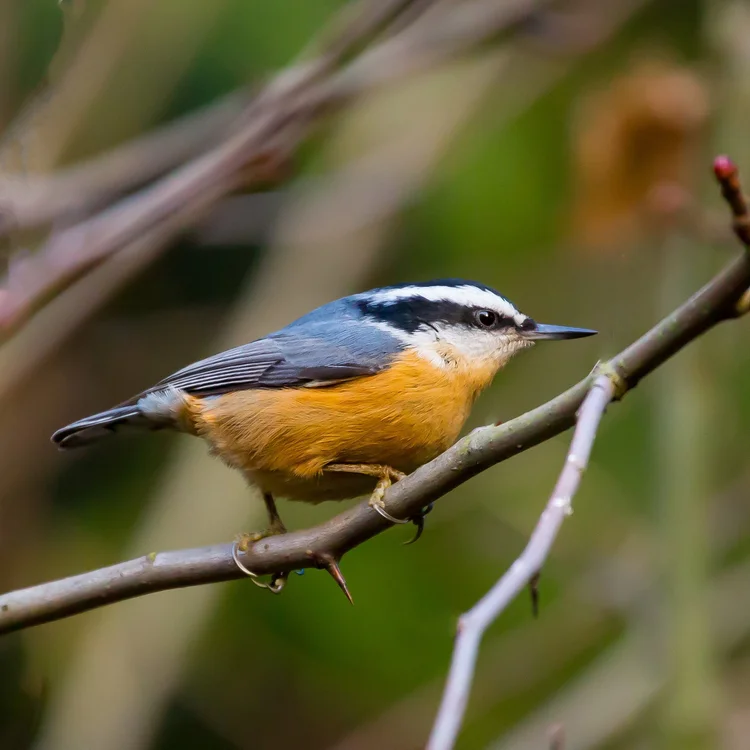
Red-breasted Nuthatch—Photo: Mick Thompson Climate Watch Winter Survey
by Joyce Volmut, Climate Watch Coordinator The winter Climate Watch survey window is coming up soon: January 15–February 15, 2026. Climate Watch is a National Audubon community science program built on the findings of Survival by Degrees, which showed that two‑thirds of North American bird species face climate‑related risks. Volunteers help test climate‑model predictions by conducting short, standardized 5‑minute surveys during the winter and breeding seasons. These surveys track how birds are responding to changing habitat and climate conditions over time. This winter, we’re looking for volunteers to help survey our region’s target species: Mountain and Western Bluebirds, Red‑breasted Nuthatches, American and Lesser Goldfinches, and Spotted Towhees. Whether you survey your backyard, your neighborhood, or a favorite birding spot, your observations contribute directly to understanding how these species are adapting. If you’re interested in participating, we’d love to have you join us. Please contact Joyce Volmut, joyce.volmut@gmail.com. Click here to learn about the survey protocols and much more. __________________
|
|
Merlin juvenile—Photo: Daniel Ellison/Audubon Photography Awards Watch Out for Merlins! by Ida Domazlicky and Jane Nicholas The OPAS area is home to an incredible small falcon called the Merlin. Its common name has no connection to Arthur’s wizard but instead takes its name from a corruption of the old French word for a female hunting falcon, esmerillon. If you keep a sharp lookout, you may be able to see this lightning-fast little hunter zip over streets, houses or farms. The Black Merlin, Falco columbarius suckleyi, is a subspecies of Merlin that formerly nested strictly in coastal forests from Washington to southeast Alaska. In the past 20 years, Black Merlins have expanded their nesting range to include forests and cities west of the Cascades, including Seattle. The other subspecies found here outside their nesting season is the Taiga Merlin, Falco columbarius columbarius. This paler Merlin subspecies nests mostly in Canada and Alaska, but migrates south through most areas of North America and even Central and South America. Whatever the subspecies, a Merlin hunts on the wing. It may land on the tippy-top of a Douglas-fir and survey the area. Finding nothing, it zooms to a tree-top a football field away and looks again. Continue reading this fascinating article. __________________
|
Helping Our Wintering Birds
|
|
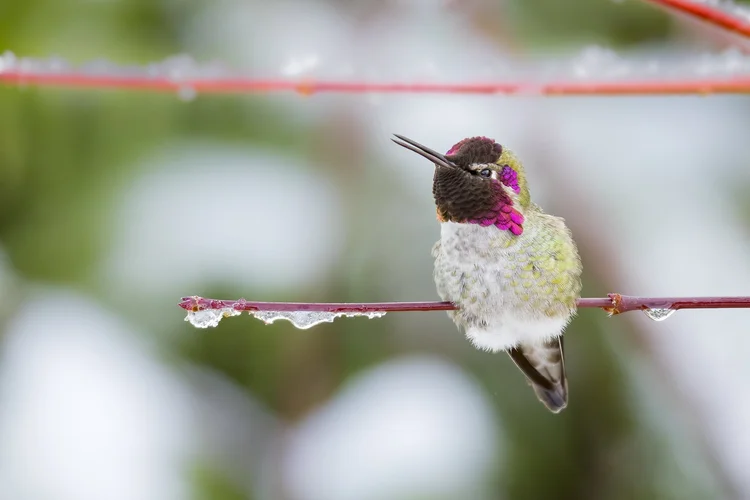
Anna’s Hummingbird in winter—Photo: Mick Thompson Helping Our Wintering Birds
by Katja Bridwell Because of our mild climate and diverse habitats, many birds remain in the region year-round rather than migrating. These resident species continue to rely on essential resources—food, water, and shelter—and some, like Anna’s Hummingbirds, may even begin nesting as early as January. While weather is always unpredictable, recent years have become increasingly erratic, adding stress to wildlife across the area. Depending on the species, birds rely on insects, seeds, fruits, and nuts for food. They also need clean water, and shelter becomes especially critical during the winter months. With our changing climate adding stress, there is much we can do to help: Delay dead-heading until spring. This may mean some plants will spread in the garden more than you desire (think plant swaps), but the seeds can feed birds well into winter and hollow plant stems are used for over-wintering insects. Also, extra vegetation provides shelter opportunities.
Continue reading about more ways to help birds. __________________
|
OPAS Backyard Birding: “Backyard Birds in Winter” Video
|
|
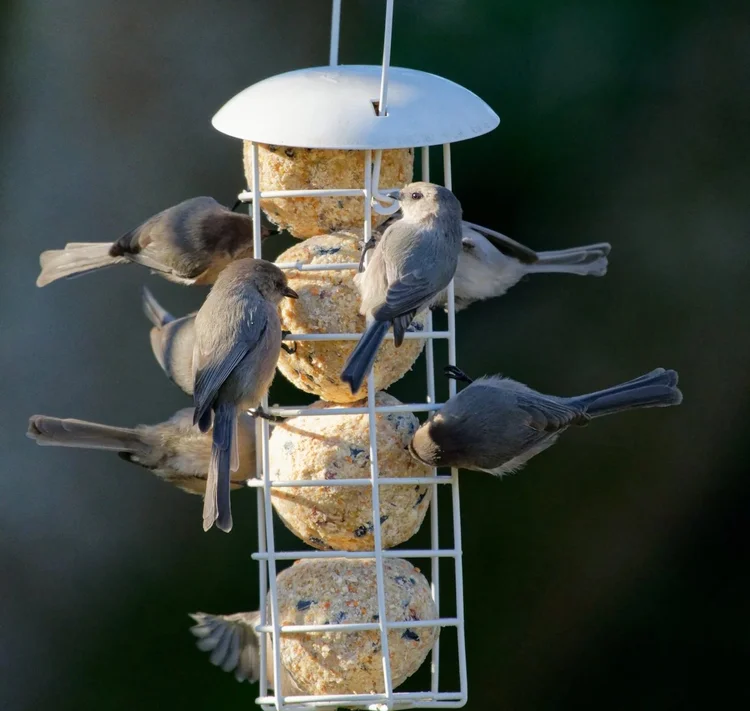
Bushtits on suet balls—Photo: Dee Renee Ericks Watch the video for a replay of Backyard Birds in Winter, presented by Ken Wiersema on December 6, 2025. This program explores how birds adapt to the challenges of the season in our unique Olympic Peninsula habitat. From winter identification tips and bird sounds to practical ways you can support feathered visitors with food, water, and shelter, the presentation offers insights for both new and experienced birders. Click here to watch the video. __________________
|
|
Evening Grosbeak female—Photo: Sally M. Harris OPAS Program: “OPAS Members’ Photo Night”
Organized by Christina Heliker
Wednesday, February 18, 2026 at 7:00 p.m.
Dungeness River Nature Center
Free to attend. For 2026 we decided to give our members a bit of a breather after the holidays and shift our OPAS Members’ Photo Night to February. This is not a contest, but a chance for members to share their favorite views of birds and their behavior. The subject of your photos needn’t be a rare bird. Our members will also enjoy a good image of a chickadee doing something interesting or just being beautiful. You may submit pictures taken locally or from your recent travels. If you have photos you would like to share, please send me a maximum of 8 images by February 6th, 2026, at the latest. That way I can get them organized in time, and everything will be ready to go. PLEASE READ THE IMAGE GUIDELINES BEFORE SENDING.
Note: If you think you are going to submit, please let me know ASAP. If more people than usual are interested, I may need to reduce the number of photos each of you can show. Important: Please review your images carefully and do all your final tweaking before you send them to me. Last-minute substitutions are strongly discouraged. Continue reading all image guidelines and learn contact information. __________________
|
Be Involved! by Audrey Gift, Membership Chairperson Thank you to all who responded to the Be Involved questionnaire recently posted to the website. We invite every OPAS member to take a few moments to complete the questionnaire as a way to let the OPAS Board know more about your interests, talents, and ideas for increasing the personal value of your membership while furthering the OPAS mission. Thank you in advance for your participation! Click here to access the questionnaire. __________________
|
|
|
|