|
$$PLAIN_TEXT_PREVIEW$$
|
Our Mission The Olympic Peninsula Audubon Society promotes birding and habitat conservation through science-based education, advocacy, and stewardship.
|
September Harlequin Happenings Newsletter
|
|
September Signals a Fresh Season at OPAS. We’re back from our summer pause and ready to dive into a full slate of fall programming.This issue highlights our September 6 Backyard Birding kickoff, a thought-provoking monthly meeting on the 17th, and two exciting field trips on the 1st and 19th. You’ll also find inspiring articles, conservation updates, and plenty of ways to connect with birds, nature, and each other. Read our past newsletters on the Newsletter page of the website.
|
|
by Matt McCoy “Many Hands” The Olympic Peninsula Audubon Society (OPAS) offers an incredible variety of activities—from field trips and educational programs to community science and bird-friendly initiatives. While we may take these activities for granted, it's our dedicated volunteers who make them all happen. Volunteers are our lifeblood. Their behind-the-scenes work keeps our chapter running smoothly. Thanks to their efforts, you can learn about events in our newsletter and register for them on our website and stay up-to-date through social media. They also handle outreach to local media, schedule speakers, and review scholarship applications. Outreach to newspapers and local officials helps spread the word about our work. Memberships, social media, and web pages get updated so you always know what’s going on. Speakers are … Continue Reading __________________
|
|
Western Sandpiper juvenile (left) and Least Sandpiper juvenile (right)— Photo: Bob Boekelheide. Dungeness Bay: Shorebirds, Gulls, and Waterfowl
Monday, September 1, 2025.
Meet at Three Crabs parking lot at 7:30 a.m.
Leader: Bob Boekelheide
Number of participants: 15 – Registration required
Free to attend (Note: Registration is full) Bird migration is in full swing as summer transitions to fall. Join Bob Boekelheide to scan the bay and mudflats for shorebirds, waterfowl, and gulls. After hopping over a few beach logs at Three Crabs beach and after surveying birds there, the group will travel to Dungeness Landing County Park on Oysterhouse Rd off Marine Drive. Dungeness Landing Park is accessible to all. If you have a spotting scope, bring it. Learn More and Register __________________
|
|
Rufous Hummingbird—Photo: Mick Thompson Backyard Birding: “Native Plants for Bees, Butterflies, and Hummingbirds”
Presenter: Julie O’Donald
Saturday, September 6, 2025, 10:00 a.m.–12:00 p.m.
Rainshadow Hall at Dungeness River Nature Center
Suggested Donation: $5 Join us for a special Backyard Birding event honoring the north Olympic Peninsula’s new designation as a Community Wildlife Habitat™ by the National Wildlife Federation. Guest speaker Julie O’Donald returns by popular demand to share how native plants support pollinators, birds, and beautiful backyard habitats. Julie's own certified wildlife habitat garden contains over 200 species of native plants. Her talk features expert tips, inspiring photography, and plant lists to take home. Come early to enjoy a baked treat, meet community leaders, and kick off the 2025–2026 Backyard Birding series with us! Learn more about the talk and about Julie at the link below. Learn More __________________
|
|
Hoh Watershed after restoration—Photo: 10,000 Years Institute OPAS Program: “Protecting Watershed Resiliency, Biodiversity and Climate: Preventing the Spread of Invasives on the Olympic Coast”
Presenter: Jill Silver, Executive Director with 10,000 Years Institute
Wednesday, September 17, 2025
Rainshadow Hall, Dungeness River Nature Center
Free to attend. Drawing on two decades of experience in coastal watershed resiliency and restoration on the Olympic Peninsula, Jill Silver will share 10,000 Years Institute’s foundational principle of protecting regenerative native plant communities from degradation by non-native invasives. Learn how these efforts support salmon recovery, forest protection, and climate resilience—while creating local stewardship jobs. Species information, field methods, and practical protocols will be shared. Childhood summers spent at Rialto Beach and the Hoh and Quillayute rivers formed Jill’s passion for this place where she is the grateful steward of 30 acres of family forest on ancestral lands of the Quileute Tribe. Learn more about the program and about Jill at the link below. Learn More __________________
|
|
Sooty Grouse, immature female — Scott Pearson/Audubon Photography Awards OPAS Field Trip: Hurricane Ridge
Leader: Kathy McCoy
Friday, September 19, 8:30 a.m to noon
Number of participants: 12—Registration required
Free to attend
|
|
Join field trip leader Kathy McCoy for a scenic morning enjoying the views and exploring high-elevation forest and meadow trails before fall storms roll in. Expect forest birds like woodpeckers, kinglets, warblers, and maybe a pipit or grouse. Kathy is hoping for fall migrants and higher elevation specialties such as Vaux’s Swift, Canada Jay, and Band-tailed Pigeon—but no promises! The group will be encouraged to keep an eye out for marmots, chipmunks, and interesting plant life. On the return drive down, Kathy may stop at some of the pull-off points to look for grouse or other surprises. Learn where to meet, recommendations about what to wear, and what to bring at the following link. Learn More and Register __________________
|
|
Pelagic Cormorants—Photo: Bob Boekelheide The Pelagic Cormorants of Port Angeles Harbor by Bob Boekelheide Pelagic Cormorants are the smallest of the three cormorant species nesting in Washington. Renowned as cliff-nesters, Pelagic Cormorants place their nests on narrow ledges of rocky cliff-faces, even inside sea caves. Their natural nesting habitat around the north Pacific Ocean is steep sea stacks and headland cliffs, where their nest placement hopefully keeps them safe from predators approaching from land and the sky. It doesn’t always work. Pelagic Cormorants formerly nested on the precipitous cliffs on the north side of Protection Island, but they apparently abandoned those nests in the last 15 years or so because of Bald Eagle flights and attacks during the nesting season. The return of Bald Eagles, following their recovery from eggshell thinning caused by DDT, has wreaked havoc for Protection Island birds, leading to nest colony abandonment not only by Pelagic Cormorants, but also by their larger cousins, Double-crested Cormorants. The nesting … Continue Reading __________________
|
Western Bluebird/Climate Watch Update
|
|
Western Bluebird—Photo: Bob Phreaner
|
|
Update by Joyce Volmut The Western Bluebird (WEBL) outperformed this year by nesting in a new spot. See nesting locations below: Happy Valley Rd with two broods, one producing three chicks and the second producing five. This is a new site. The owners have lived there for over 20 years and they have never had WEBL nesting on their property. They called me to report the nesting after talking to Christie at Wild Birds Unlimited. Miller Peninsula with 5 eggs identified in one of the boxes. Unfortunately, the outcome couldn’t be determined at this site. The next check, about 5 weeks later, revealed House Wrens had taken over the nest. River Rd with two broods in one box, three eggs in the first brood and 4 eggs in the second. Report from eBird about an observer at Olympic National Park’s Obstruction Pt Rd on 6/29 saw a Western Bluebird entering a cavity with food (confirmed by photo); 7/17 (same site) saw three fledglings (confirmed by photo and sound recording).
The OPAS Western Bluebird/Climate Watch is now over 10 years old. It was started as a means of collecting information … Continue Reading ______________
|
|
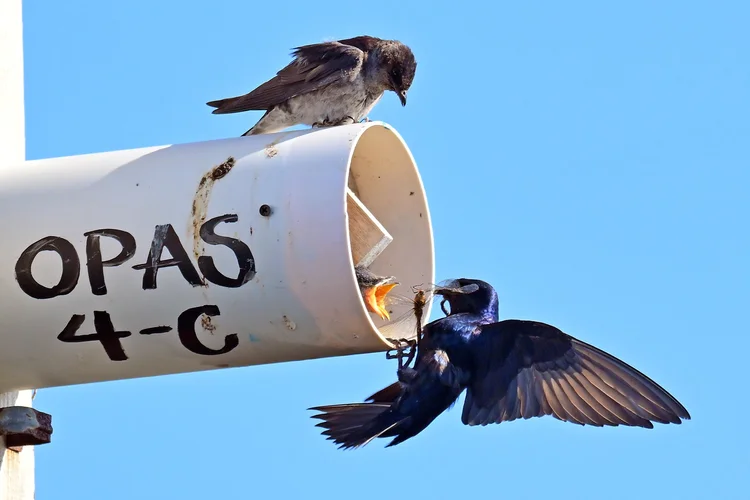
Male Purple Martin feeding chick a dragonfly while female watches—Photo: Dow Lambert Final 3 Crabs Nest CheckPhotos and information provided by Dow Lambert and compiled by Dee Renee Ericks On August 8th at 0730, Dow Lambert, Ken Wiersema and members of the Purple Martin team strode across the sandy tidal flats to the 18 nest boxes of the 3 Crabs Colony. This was the fourth and final nest box check for 2025. Weather conditions were slightly overcast, 59 degrees, and calm, with the low tide just hitting -0'6". Conditions were ideal. Dow observed multiple fledglings out of the nest, begging for food. Dragonflies are one of the primary insects fed to Purple Martin nestlings, and are now more plentiful with warmer temperatures. This summer has had relatively low temperatures in June and July which has delayed bug hatches. The team found that the sixteen nest boxes offshore had … Continue Reading __________________
|
OPAS Getting “Good Press” from City and County Officials by Rhonda Coats, Publicity Chair Recently, the OPAS environmental initiative, the North Olympic Wildlife Habitat Project, has caught the attention of elected officials generating a series of proclamations from the City of Sequim (July 28), the Board of Clallam County Commissioners (August 19), and anticipated from the City of Port Angeles (September 2). All proclamations are similarly worded to the version signed by the county commissioners. Click here to read the proclamation as a PDF. These documents acknowledge the efforts of OPAS and our local project partners (Dungeness River Nature Center and Wild Birds Unlimited) that have gained National Wildlife Federation recognition of the north Olympic Peninsula as a Community Wildlife Habitat™ as well as an ongoing commitment to expand the number of certified properties in our area into “wildlife corridors” connecting with established natural areas. Continue Reading __________________
|
|
Golden-crowned Sparrow—Photo: Dow Lambert OPAS Field Trip: "Birding for Everyone"
Leader: Marie Grad
Saturday October, 18, 9:00 a.m.
Meet in the parking lot of the Dungeness River Nature Center Participant limit: 12— Registration required
Free to attend Fall migration is in full swing during October. Even though there are many species of birds that are yearlong residents, some birds will migrate to their wintering habitats, while others will arrive here to spend the winter. White-crowned Sparrows will be replaced by Golden-crowned Sparrows for example. Everyone is welcome; however, this trip is intended for individuals who are new to birding. Bring binoculars if you have them, but the River Center has loaner binoculars. Marie will have a spotting scope to share. Learn More and Register __________________
|
|
|
|